

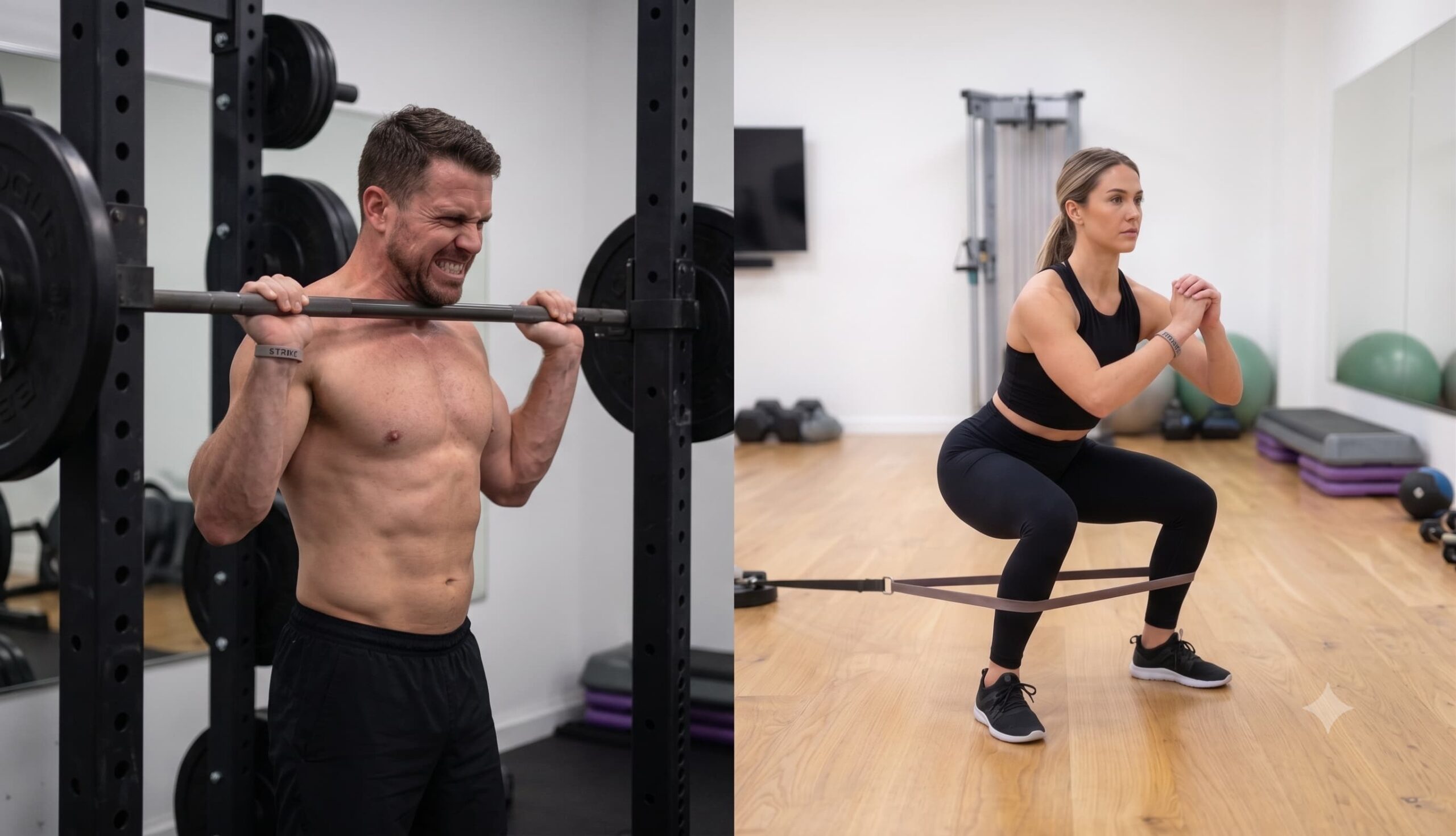
Overcoming vs. Yielding Isometrics
Overcoming vs. Yielding Isometrics: Two Tools, Two Very Different Jobs
This article is general information, not medical advice. See the note at the end.
Isometric exercise gets lumped into one bucket — “hold this position” — but that flattens out a distinction that actually matters. There are two very different types of isometric contraction, and they do two very different jobs. Mix them up, and you’ll either underload an athlete trying to get stronger, or overload a joint that’s supposed to be calming down.
Here’s the honest, no-fluff breakdown: what overcoming and yielding isometrics actually are, how to perform each one properly, and — the part that matters most — when to reach for which.
What makes a contraction “isometric” in the first place
In an isometric contraction, the muscle produces force without changing length and without moving the joint. No lifting, no lowering — just tension. That’s different from a concentric contraction (muscle shortens, like the “up” of a bicep curl) or an eccentric one (muscle lengthens under load, like slowly lowering that same curl).
Isometrics split into two distinct types depending on what you’re pushing against:
Overcoming isometrics: maximal effort against something that won’t move
What it is: You push or pull with maximal effort against a resistance that cannot move — a bar locked against pins in a rack, an immovable wall, a partner holding firm. The muscle tries to shorten and “win,” but the resistance doesn’t budge, so no movement happens. [2]
Example: Pressing a barbell up into safety pins set just below lockout in a bench press, and driving as hard as possible for a few seconds. Other examples include pushing against a wall with full effort, or driving into an immovable bar in a squat rack.
How to perform it: Set the resistance so it genuinely cannot move — pins in a rack are the gold standard, since a wall or partner can shift slightly and undercut the effort. Ramp up over the first couple of seconds, then push with everything you’ve got for the remaining duration. A commonly cited protocol is near-maximal effort (roughly 80–100% of your max) held for a short 3–10 second burst, for a handful of sets. [1][2] Full recovery between sets matters here — this is a maximal-effort tool, not an endurance one.
What it’s used for: This is a training tool, not typically a rehab one. Overcoming isometrics ask your nervous system to recruit as many motor units as possible, as forcefully as possible, right now. Research shows this style of training can meaningfully increase maximal force production, and a systematic review found that training intent — trying to contract as explosively and forcefully as possible, even though nothing moves — significantly improves neuromuscular activation and rapid force development. [1] High-intensity isometric holds (roughly 70% of max effort or higher) have also been linked to improvements in tendon stiffness and structure over time. [1]
In plain terms: overcoming isometrics are for building raw force production and toughening up the tissue (muscle and tendon) that has to handle it — which is exactly why we use them with people trying to get stronger or more powerful, not people trying to calm an angry joint down.
One important caveat: the strength gains from isometric training are fairly joint-angle specific — you get the most improvement at the angle you actually trained, with less carryover to other joint positions. [1][3] That’s why overcoming isometrics work best as one piece of a program that also includes full-range strength work, not a replacement for it.
Yielding isometrics: holding a position against a load that’s trying to move you
What it is: You hold a joint position steady while resisting a real load that’s actively trying to move it — gravity, a weight, your own bodyweight — for an extended period. Instead of pushing against something immovable, you’re doing the opposite: staying still while something is actively trying to push, pull, or collapse you.
Example: A wall sit, holding at the bottom of a squat, a Spanish squat hold, or a mid-range plank. In each case, you’re not maximally straining against something rigid — you’re maintaining a joint angle under a real, sustained load.
How to perform it: These are typically lower-intensity and longer-duration than overcoming isometrics. Common protocols use holds in the 30–45 second range, sometimes performed at a moderate effort (roughly 70–80% of maximum) rather than an all-out max. [4][5] Because the load itself is doing the work of trying to move you, the emphasis is on control and a steady, sustainable position rather than an explosive push.
What it’s used for: This is where yielding isometrics earn their reputation as a rehab tool. They let you load a muscle or tendon under a controlled, pain-manageable position — useful for tendinopathy (irritated, overloaded tendons like the patellar or Achilles tendon) and for easing back into loading after an injury, since you can find a joint angle that keeps things pain-free while still building capacity. [3]
The honest evidence on isometrics for pain relief: This is a case where we want to be straight with you rather than oversell it. A widely cited 2015 study found that a single bout of isometric holds gave volleyball players with patellar tendinopathy immediate, significant pain relief that lasted at least 45 minutes — more than an equivalent set of dynamic exercise. [6] It’s a genuinely useful finding, and it’s part of why isometrics became popular in tendon rehab.
But later research complicates the picture. A systematic review and meta-analysis pooling multiple studies found the pain-relief effect is inconsistent — some tendons and some people respond well, others don’t, and for conditions like plantar fasciopathy only a minority of people got meaningful relief. [7] The honest conclusion: isometric holds don’t appear to be reliably superior to other forms of exercise for calming tendon pain long-term, even though many people do get a genuine, useful window of pain relief that makes the rest of a session more manageable. [7]
That’s exactly why we don’t sell yielding isometrics as a guaranteed pain-relief switch. We use them as one tool to help someone tolerate loading during rehab — and if a particular hold doesn’t ease your pain, that’s useful information, not a failure.
Overcoming vs. yielding, side by side
| Overcoming | Yielding | |
| Resistance | Immovable (can’t move no matter how hard you push) | Movable load you’re actively resisting |
| Effort | Maximal, explosive intent | Moderate, sustained control |
| Duration | Short (a few seconds per rep) | Longer (30–45+ seconds per hold) |
| Primary goal | Force production, motor unit recruitment, tendon stiffness | Pain-manageable loading, building tissue tolerance |
| Typical use | Strength and performance training | Rehab and early-stage loading |
When we use each at Strike
Overcoming isometrics show up when someone’s goal is building strength, power, or force production — think an athlete working on a sticking point in their lift, or someone whose tendons need to handle heavier loads down the line. It’s a training tool for tissue that’s ready to be pushed hard.
Yielding isometrics show up early in rehab, when a joint or tendon is irritated and needs loading it can actually tolerate — a manageable, sustained hold rather than a maximal push. From there, we progress people toward heavier and more dynamic loading as their tissue capacity improves, rather than leaving them on isometrics indefinitely.
Neither one replaces a full training or rehab program — they’re tools that get slotted in at the right point for the right reason. Using an all-out overcoming isometric on an angry, irritated tendon would be the wrong call; using only gentle yielding holds with an athlete trying to build raw strength would leave a lot on the table.
Frequently asked questions
Can I do these at home without a gym? Some yielding isometrics, yes — wall sits and similar bodyweight holds need no equipment. True overcoming isometrics need a genuinely immovable resistance (like rack pins), so they’re better suited to a gym setting.
Are isometrics safe if I have an existing injury? Often, yes, since you can typically find a pain-manageable joint angle — but “often” isn’t “always,” and the right angle, load and duration depend on your specific issue. This is exactly the kind of decision worth getting a professional assessment for rather than guessing.
Will isometrics build muscle the same way regular training does? They can contribute to hypertrophy, particularly when held at longer muscle lengths, but they’re typically used alongside full dynamic training rather than as a total replacement. [1]
How do I know which one I need? It comes down to your goal and your tissue’s current state. Building strength and performance points toward overcoming; managing an irritated tendon or easing back into loading points toward yielding. A practitioner can assess where you’re at and tell you which is the right tool right now.
Get the right tool for where you’re at
Isometrics are a genuinely useful piece of a program — but only when the right type is matched to the right goal and the right stage of tissue tolerance. If you’re an athlete looking to build force production, or you’re dealing with nagging tendon pain and want a smarter way back to full loading, our team can assess what you actually need and build isometrics into a plan that makes sense for your body.
Ready to train or rehab the right way? Book online or reach out — we’ll walk you through it.
A note on this article
This article is provided for general educational purposes only and is not a substitute for professional medical advice, diagnosis, or treatment. Exercise recommendations, including isometric training, should be tailored to the individual — what’s appropriate depends on your specific condition, pain levels, and goals. Before starting a new isometric training or rehab protocol, especially if you have an existing injury or persistent pain, consult a qualified healthcare professional for an assessment.
References
- Oranchuk DJ, Storey AG, Nelson AR, Cronin JB. Isometric training and long-term adaptations: Effects of muscle length, intensity, and intent: A systematic review. Scandinavian Journal of Medicine & Science in Sports (2019). https://onlinelibrary.wiley.com/doi/10.1111/sms.13375
- Overview of overcoming isometric contractions and their application to maximal strength development in strength and conditioning practice. https://www.athleticlab.com/can-isometric-training-increase-strength-by-gaby-smith/
- Isometric training allows tightly controlled force application within pain-free joint angles in rehabilitative settings; joint-angle specificity of strength gains. https://www.humanlocomotion.com/oranchuk-d-et-al-isometric-training-and-long-term-adaptations-effects-of-muscle-length-intensity-and-intent-a-systematic-review-scand-j-med-sci-sports-20191-20/
- Pearson SJ, et al. Comparison of isometric loading protocols (10 s vs. 40 s holds) for patellar tendinopathy pain. Referenced in: Effectiveness of isometric exercise in the management of tendinopathy: a systematic review and meta-analysis of randomised trials. https://pmc.ncbi.nlm.nih.gov/articles/PMC7406028/
- Overcoming isometric training protocols and recommended effort/duration guidelines for strength development. https://straydogstrength.com/blogs/articles/overcoming-isometrics
- Rio E, Kidgell D, Purdam C, et al. Isometric exercise induces analgesia and reduces inhibition in patellar tendinopathy. British Journal of Sports Medicine (2015). https://pmc.ncbi.nlm.nih.gov/articles/PMC7406028/
- Effectiveness of isometric exercise in the management of tendinopathy: a systematic review and meta-analysis of randomised trials (found conflicting evidence for immediate pain relief across tendons and populations). https://pmc.ncbi.nlm.nih.gov/articles/PMC7406028/