

Standing Desks vs. Sitting: What the Evidence Actually Says
Standing Desks vs. Sitting: What the Evidence Actually Says
Standing desks went from novelty to office staple in about a decade, propelled by headlines declaring that “sitting is the new smoking.” The reality is more measured than the marketing. Standing desks can be genuinely useful — but for reasons slightly different from what’s usually claimed, and only if you use them properly.
The “Sitting Is the New Smoking” Claim
A necessary correction: This comparison isn’t supported by the evidence and has been criticised by researchers in the field. Prolonged sedentary behaviour is associated with various health risks, but the magnitude is nowhere near that of smoking. Notably, much of the risk associated with sitting appears attenuated in people who are otherwise physically active. Overstating the case doesn’t help anyone make good decisions.
What Standing Desks Actually Do
For Musculoskeletal Discomfort
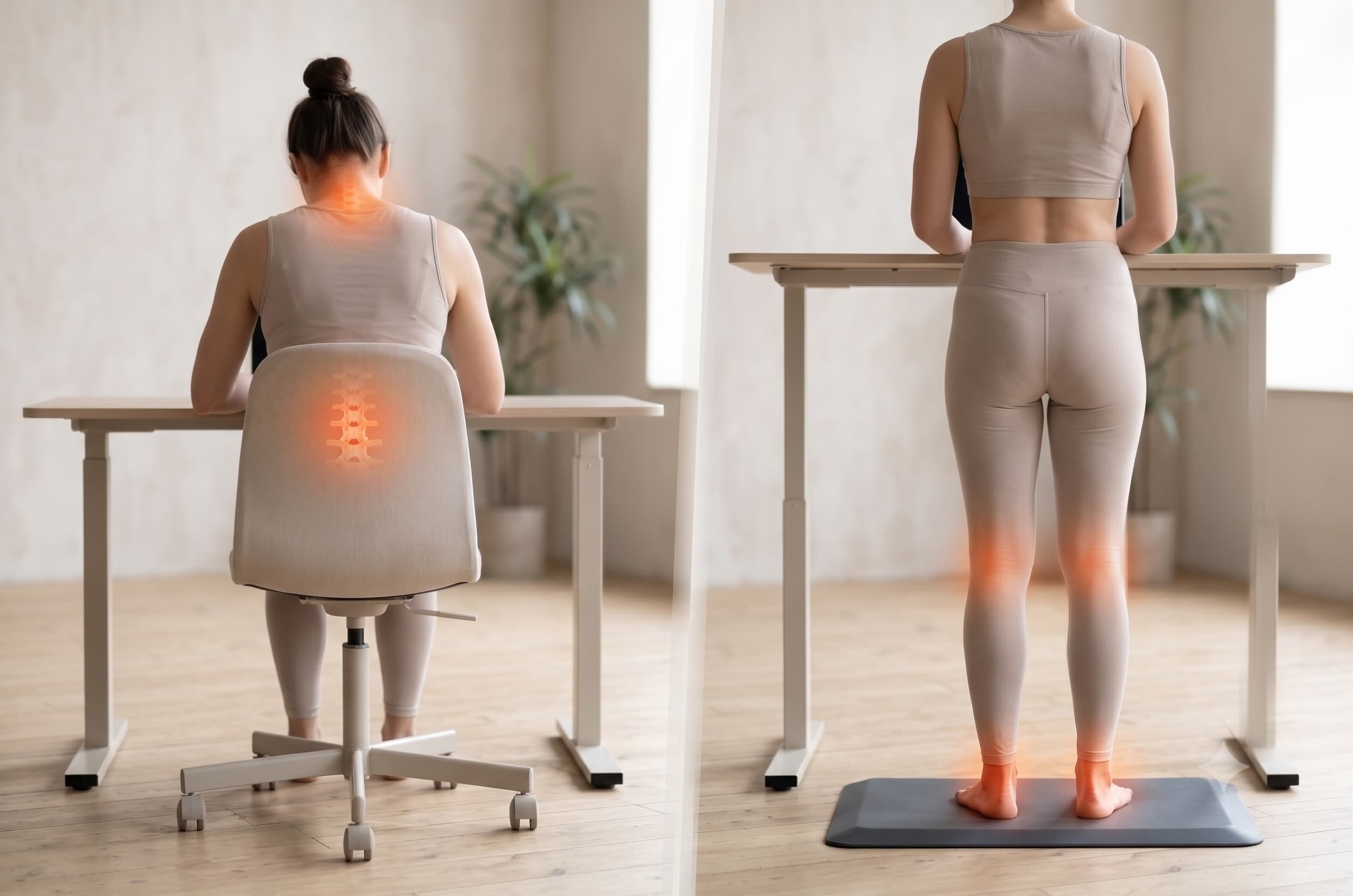
This is where the evidence is most encouraging. Studies of sit-stand desks generally show reductions in reported back and neck discomfort among office workers. If you have desk-related back pain, a sit-stand desk is a reasonable thing to try.
For Sedentary Time
Sit-stand desks do reliably reduce sitting time at work — typically by an hour or more per day. Whether that translates into meaningful long-term health outcomes is less established, but reducing prolonged static sitting is sensible regardless.
For Metabolic Health
Effects on markers like blood glucose and cholesterol appear modest. Standing burns only slightly more energy than sitting — the difference over a workday is small. A standing desk is not a substitute for exercise.
For Productivity
Evidence is mixed; most studies find no meaningful negative effect on work performance, with some suggesting modest benefits. It’s unlikely to hurt your output.
The Key Insight: Alternation, Not Standing
The most important point: The benefit isn’t standing — it’s changing position. Standing all day creates its own problems: leg fatigue, lower back discomfort, foot pain, and for some people, increased lower limb swelling. Research on prolonged standing at work shows it has its own musculoskeletal costs. A sit-stand desk is valuable because it makes changing position easy, not because standing is inherently superior.
How to Use a Standing Desk Properly
- Alternate regularly: Switch every 30-60 minutes rather than committing to long blocks of either
- Build up gradually: Start with 15-20 minutes of standing at a time and increase over weeks. Going from all-day sitting to all-day standing reliably produces sore feet and legs
- Set the height correctly: Elbows at roughly 90 degrees, screen at eye level — the same principles as sitting
- Use an anti-fatigue mat: Standing on a hard floor for extended periods is uncomfortable; a cushioned mat helps considerably
- Wear supportive footwear: Standing in unsupportive shoes or bare feet on hard floors adds to fatigue
- Shift your weight: Don’t stand rigidly. Move, shift, use a footrest to alternate weight
Who Should Be Cautious
Prolonged standing may not suit everyone. Consider extra care — and speak with a healthcare provider — if you have varicose veins, circulatory conditions, significant foot or knee arthritis, or are pregnant (prolonged standing can increase swelling and discomfort).
What Matters More Than Your Desk
Honestly, if you had to choose where to invest effort:
- Regular movement breaks: Getting up and walking briefly every half hour or so — more valuable than which position you’re in
- Regular exercise: Strength training and cardiovascular activity outside work hours
- General daily activity: Walking, stairs, active commuting
- Screen height: Whether sitting or standing, this drives your neck position
A standing desk used well is a helpful addition to these. It isn’t a replacement for any of them.
The Practical Bottom Line
Sit-stand desks are worth having if you can — mainly because they make position changes effortless, and there’s reasonable evidence they reduce back and neck discomfort. Use them by alternating regularly rather than standing all day, build up gradually, and don’t expect them to substitute for exercise. If you can’t get one, frequent standing and walking breaks achieve much of the same benefit.
Desk-related back or neck pain that a new desk hasn’t fixed? Our physiotherapists can assess what’s actually driving it and build a plan that works. Book your assessment.
Medical Disclaimer
This blog post is for informational purposes only. This is not medical advice. Consult a healthcare provider for persistent pain or before making changes if you have circulatory conditions, are pregnant, or have other health concerns.
Sources & References
- Chambers, A. J., Robertson, M. M., & Baker, N. A. (2019). The effect of sit-stand desks on office worker behavioral and health outcomes: A systematic review. Applied Ergonomics, 78, 37-53.
- Agarwal, S., Steinmaus, C., & Harris-Adamson, C. (2018). Sit-stand workstations and impact on low back discomfort: A systematic review and meta-analysis. Ergonomics, 61(4), 538-552.
- Shrestha, N., Kukkonen-Harjula, K. T., Verbeek, J. H., et al. (2018). Workplace interventions for reducing sitting at work. Cochrane Database of Systematic Reviews, 6, CD010912.
- Vallance, J. K., Gardiner, P. A., Lynch, B. M., et al. (2018). Evaluating the evidence on sitting, smoking, and health: Is sitting really the new smoking? American Journal of Public Health, 108(11), 1478-1482.
- Coenen, P., Parry, S., Willenberg, L., et al. (2017). Associations of prolonged standing with musculoskeletal symptoms: A systematic review of laboratory studies. Gait & Posture, 58, 310-318.
- Ekelund, U., Steene-Johannessen, J., Brown, W. J., et al. (2016). Does physical activity attenuate the detrimental association of sitting time with mortality? The Lancet, 388(10051), 1302-1310.
- Karakolis, T., & Callaghan, J. P. (2014). The impact of sit-stand office workstations on worker discomfort and productivity. Applied Ergonomics, 45(3), 799-806.
- Waongenngarm, P., Areerak, K., & Janwantanakul, P. (2018). The effects of breaks on low back pain, discomfort, and work productivity in office workers. Applied Ergonomics, 68, 230-239.