

Do Custom Orthotics Actually Work?
Do Custom Orthotics Actually Work? An Honest Guide to When They’re Worth It
This article is general information, not medical advice. See the note at the end.
Ask ten people about custom orthotics and you’ll get ten different answers. Some swear they fixed years of foot and knee pain. Others call them an expensive scam. So who’s right?
Here’s how we do things at Strike: straight talk, backed by the science. Orthotics aren’t magic, and they’re honestly not for everyone. But for the right person — the right foot, the right problem — they can be a real difference-maker. The whole game is figuring out whether you’re that person. Let’s break it down, no hype.
First — what actually is a custom orthotic?
You’ve seen the drugstore insoles: mass-produced, one-shape-fits-most cushions you slide into your shoe. Those are prefabricated (off-the-shelf) orthotics, and for a lot of people they do a perfectly good job.
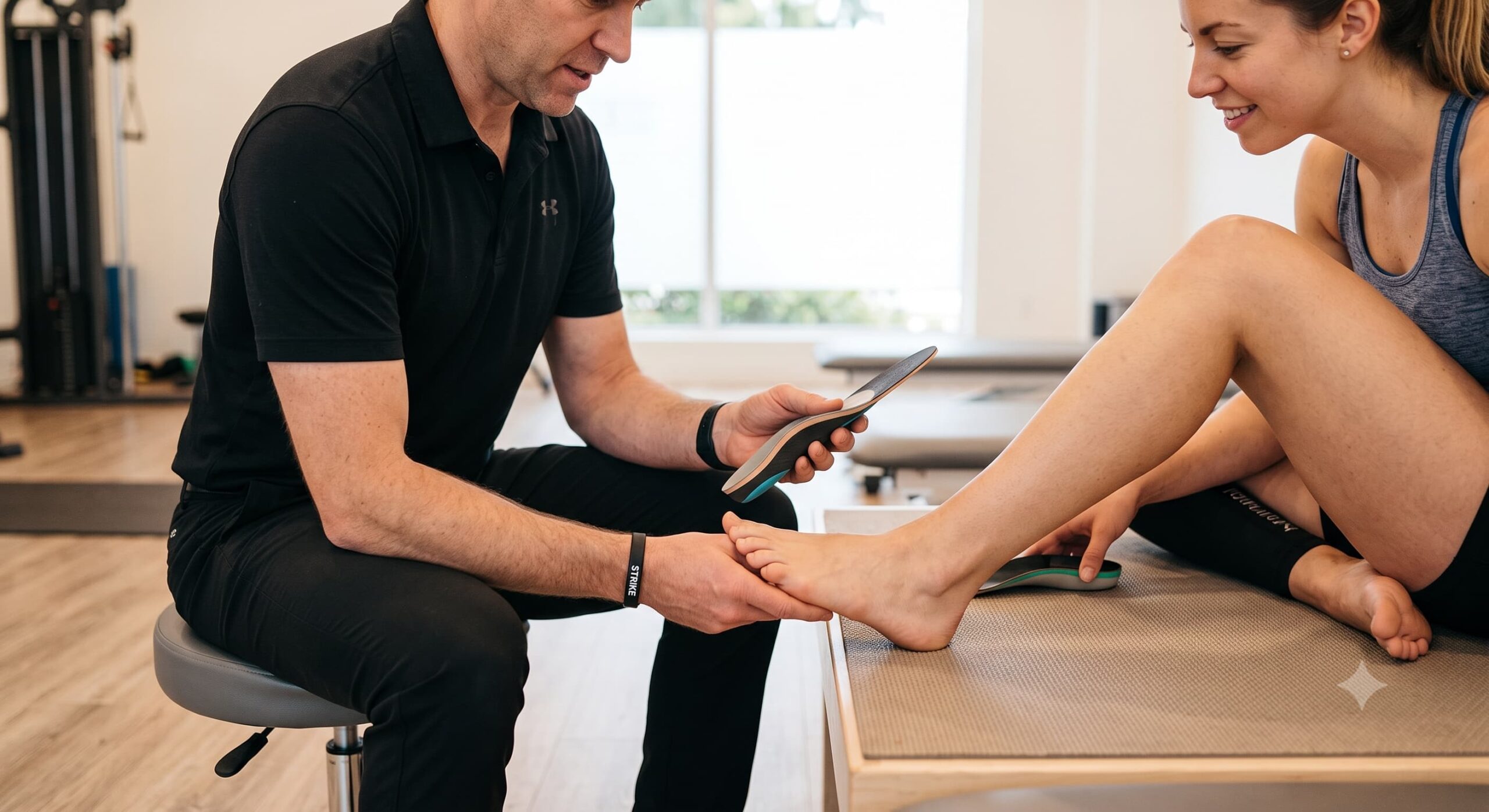
A custom orthotic is different. It’s built specifically for your feet, based on a hands-on biomechanical assessment — how you stand, how you walk, where your load goes, and where your mechanics are creating problems. The goal isn’t just cushioning; it’s to change how force moves through your foot and lower limb, to take strain off the tissue that’s hurting.
That extra precision is the whole reason custom orthotics cost more — and it’s also why they’re worth it for some people and overkill for others.
What the science actually says (the honest version)
We’re not going to tell you orthotics are a miracle cure, because the research doesn’t say that. Here’s the real picture:
Heel pain and plantar fasciitis — this is where the evidence is strongest. A systematic review and meta-analysis found moderate-quality evidence that foot orthoses reduce plantar heel pain in the medium term (roughly 7–12 weeks). [1] For plantar fasciitis specifically, custom semi-rigid orthotics have shown moderate-to-large benefits. [4] If you’ve got stubborn heel pain, orthotics are a legitimate tool.
Injury prevention for high-mileage folks — for people who load their feet hard (runners, people on their feet all day, military recruits in training), orthoses can lower the risk of common overuse injuries. One systematic review and meta-analysis found roughly a 34% reduction in lower-limb overuse injuries like shin splints, patellofemoral pain, Achilles issues and plantar fasciitis. [3] Across the general population the prevention evidence is weaker — so this is about specific high-load situations, not a blanket promise.
Knee (patellofemoral) pain — mixed. Some people get real relief; in one trial, only about four people needed to be treated for one extra person to improve. [4] But other research shows orthotics may be no better than good insoles or a solid exercise program for knee pain. [5] Translation: worth trying for the right person, not a sure thing.
Custom vs. off-the-shelf — here’s the honest kicker. For straightforward heel pain, studies often find no meaningful difference between custom and quality prefabricated orthotics. [1][2] That’s exactly why we won’t push a custom pair on someone a $60 insole would help just as well.
Who custom orthotics genuinely help
Based on the evidence and what we see in the clinic, custom orthotics tend to earn their keep for:
- Persistent plantar fasciitis or heel pain that hasn’t settled with stretching, footwear changes and load management.
- Flat feet or significant overpronation that’s actually causing symptoms (not just “flat feet” on their own — plenty of flat feet are pain-free and need nothing).
- High, rigid arches that don’t absorb shock well.
- Posterior tibial tendon problems and certain arch-collapse issues.
- Some knee, shin or hip overuse pain where foot mechanics are a genuine driver.
- People who load their feet hard all day — nurses, tradespeople, retail workers, high-mileage runners.
- Feet with unusual structure or a real leg-length difference, where off-the-shelf simply can’t accommodate the shape.
Notice the theme: it’s not “everyone.” It’s “specific problems where foot mechanics are part of the story.”
Off-the-shelf vs. custom: the honest call
A quality prefabricated insole is often enough when: your issue is straightforward, your feet are fairly typical, and you just need better support and cushioning than your shoe provides. Cheaper, faster, and for simple cases the results can be comparable. [1][2]
Custom is worth the investment when: off-the-shelf hasn’t worked, your foot structure is unusual, you have a specific mechanical fault that needs targeted correction, you’re loading your feet heavily day after day, or you need durability and a precise, repeatable fit. This is where paying for custom actually buys you something the drugstore version can’t.
We’ll tell you honestly which camp you’re in. If a $40 insole will do the job, that’s what we’ll say.
How we approach orthotics at Strike Recovery
Two things set apart the way we do this:
We assess first, prescribe second. Before anyone talks about a custom orthotic, a practitioner assesses your feet, your gait and your mechanics to figure out whether orthotics will actually help you — and whether custom or prefab makes more sense. No assessment, no sales pitch.
Orthotics are part of a plan, never the whole plan. An orthotic can offload cranky tissue and change your mechanics, but it doesn’t strengthen a weak foot, loosen a tight calf, or fix a training error. So we pair them with the stuff that creates lasting change — targeted strengthening, footwear guidance, and hands-on treatment. Best-practice care for foot pain uses orthotics as one step in a bigger approach, not a magic insole you drop in and forget. [5]
That combination — the right tool, for the right person, inside a real plan — is what actually gets results.
What to expect
If custom orthotics are right for you, there’s usually a short break-in period as your feet adapt — we’ll start you off wearing them for a few hours a day and build up. Most people find them comfortable within a couple of weeks. A well-made pair, worn in appropriate footwear, typically lasts a few years, though the top covers may need refreshing sooner. We’ll fine-tune the fit if anything feels off.
Frequently asked questions
Are custom orthotics covered by insurance? Often, yes. Many extended health plans in BC cover custom orthotics, usually requiring a biomechanical assessment and a prescription. We can guide you through that process and direct-bill where your plan allows — bring your details and we’ll check what’s covered before you commit to anything.
Do I have to wear them forever? Not always. For some people they’re a long-term support; for others they’re a tool to get through a flare-up while we address the root cause, after which you may need them only for high-load activities. It depends on your situation.
Can’t I just buy insoles from the drugstore? For simple issues, absolutely — and we’ll tell you if that’s your best bet. Custom becomes worth it when off-the-shelf isn’t cutting it or your feet need something more specific.
Will orthotics fix my problem on their own? Rarely. They work best combined with the right exercises and footwear. Think of them as one piece of the puzzle, not the whole picture.
Ready to find out if orthotics are right for you?
You shouldn’t have to guess — or get sold a pricey pair of insoles on a hunch. If you’re in North Burnaby and dealing with nagging foot, heel, knee or lower-limb pain, come in for an assessment. We’ll figure out what’s actually driving it, tell you honestly whether orthotics will help, and build you a plan that fits your feet and your life.
Ready to get moving comfortably again? Book online or reach out — we’ll give it to you straight.
A note on this article
This article is provided for general educational purposes only and is not a substitute for professional medical advice, diagnosis, or treatment. Foot mechanics and pain are individual — orthotics help some conditions and people more than others, and are not appropriate for everyone. Before starting orthotic therapy, especially if you have diabetes, a circulatory condition, an existing injury or persistent pain, consult a qualified healthcare professional for an assessment.
References
- Whittaker GA, et al. Foot orthoses for plantar heel pain: a systematic review and meta-analysis. British Journal of Sports Medicine (2018). https://pubmed.ncbi.nlm.nih.gov/28935689/
- Custom-Made Foot Orthoses versus Prefabricated Foot Orthoses: A Review of Clinical Effectiveness and Cost-Effectiveness (CADTH). https://www.ncbi.nlm.nih.gov/books/NBK549527/
- Systematic review and meta-analysis on the effects of foot orthoses on pain and the prevention of lower limb injuries in runners and recruits (approx. 34% reduction in overuse injuries). https://www.ncbi.nlm.nih.gov/pmc/articles/PMC4567833/
- Effectiveness of foot orthoses for treatment and prevention of lower limb injuries: a review (custom semi-rigid orthoses show moderate-to-large effects for plantar fasciitis and posterior tibial stress fractures). https://pubmed.ncbi.nlm.nih.gov/18712943/
- Management of plantar heel pain: a best-practice guide (stepped-care use of custom orthoses alongside stretching, taping and education). https://www.ncbi.nlm.nih.gov/pmc/articles/PMC8458083/