

Recovery Tools the Pros Use
Recovery Tools the Pros Use: Do NormaTec, Percussion and Tecar Therapy Actually Work?
This article is general information, not medical advice. See the note at the end.
Walk into any pro locker room and you’ll see it: athletes zipped into compression boots, hammering a percussion device over their quads, or wired up to a machine most people have never heard of. For years, that kind of recovery tech was locked behind pro-team budgets and full-time therapists.
We looked at that and thought: why? If the science says these tools help athletes recover and feel better, everyone should be able to walk in and use them. The marathoner. The rec-league grinder. The person chasing a deadlift PR after a nine-hour workday. The grandparent who refuses to slow down. Same body, same principles — same access.
That’s the whole idea behind Strike. Pro-level recovery, minus the pro contract. So let’s cut the hype and get into it: here’s what each tool actually does, what the evidence really says, and how to put it to work for you.
First — what does “recovery” even mean?
Recovery is simply your body repairing and adapting after you’ve stressed it: a hard workout, a long day on your feet, a rehab session. When recovery keeps pace with what you throw at your body, you feel good and you get stronger. When it falls behind, you get that heavy, run-down, everything-aches feeling — and your risk of nagging injuries climbs.
Straight talk before we start: recovery tools don’t replace the fundamentals. Sleep, nutrition and smart training always do the heavy lifting. What good recovery tech does is help you feel better faster, move more freely, and get more out of the training or rehab you’re already doing. Accelerators, not magic. With that on the table — let’s meet the tools.
Dynamic compression (NormaTec): the “fresh legs” button
You’ve seen it — someone kicked back with what look like inflatable boots running up to their hips. That’s dynamic compression, and NormaTec is the name everyone knows.
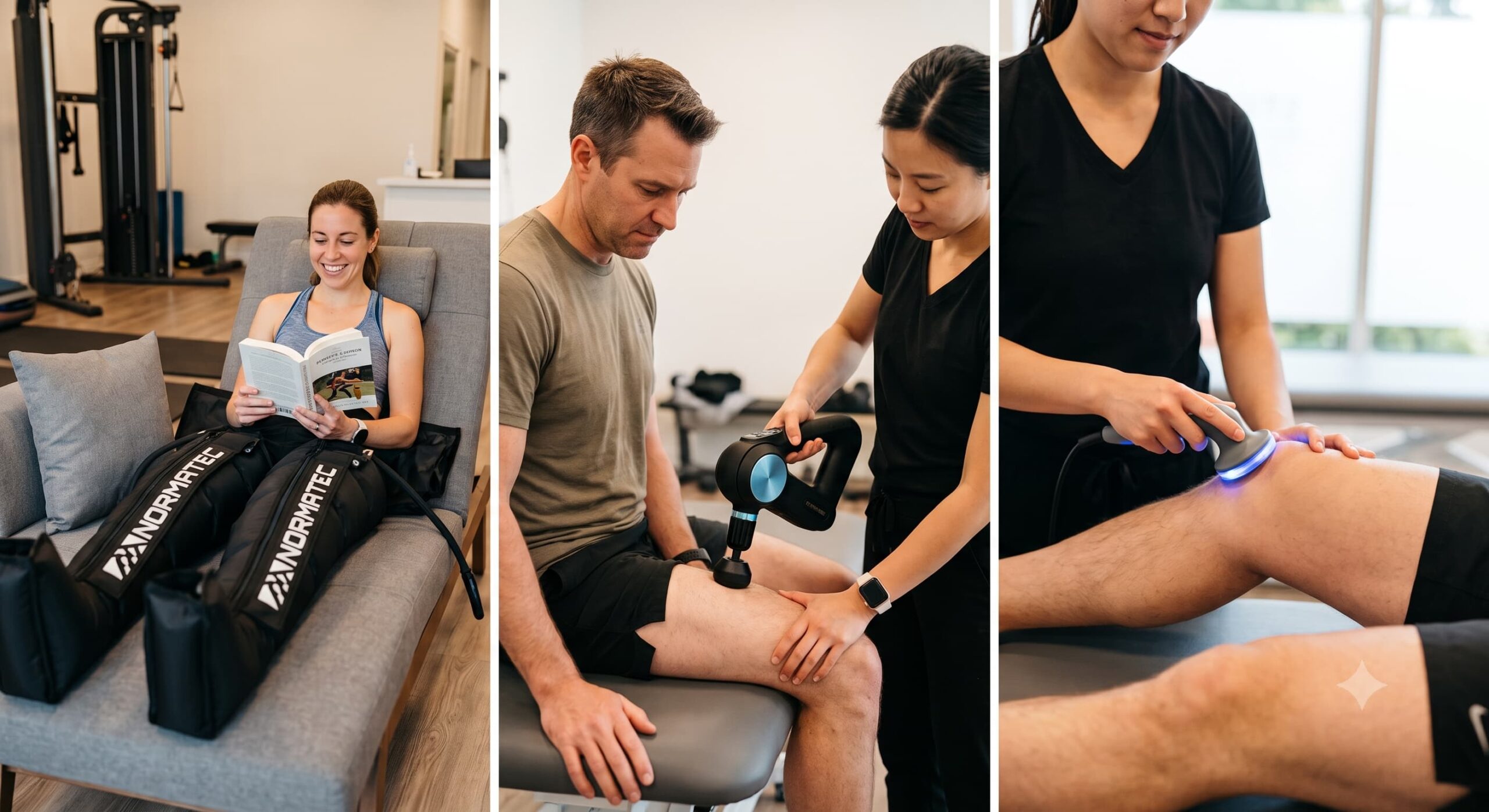
What it does: The device inflates in a pulsing, wave-like pattern from your feet upward, gently squeezing your limbs. That massaging action helps move fluid and can leave your legs feeling lighter and less heavy after a hard session.
What the science says: A 2024 systematic review and meta-analysis found that lower-limb intermittent pneumatic compression offers a trivial-to-small benefit for muscle function and a trivial-to-moderate benefit for pain and soreness — its clearest win is on perceived soreness, i.e. how recovered your legs actually feel. [1] Translation: don’t expect it to rewrite your performance numbers, but “my legs feel fresh for tomorrow” is a real, repeatable win.
Who it’s for: Runners after long efforts, anyone with heavy, achy legs post-training, people on their feet all day, and folks bouncing back from lower-limb issues. Bonus: it’s genuinely relaxing — a lot of people treat a session as 15–20 minutes of enforced chill.
Legs feeling like concrete after leg day? Come put them in the boots. Book online.
Percussion therapy: instant “loosen me up”
Those handheld “massage guns” you keep seeing? That’s percussion therapy — rapid pulses driven into a muscle. We run professional-grade versions of these as part of hands-on treatment.
What it does: The rapid tapping boosts local blood flow, dials down that tight, bound-up feeling, and can make a stiff area move noticeably better within minutes.
What the science says: Research backs percussive massage for short-term improvements in muscle soreness and range of motion — though it won’t add raw strength. [2][3] Zoom out and massage after hard exercise has solid evidence for cutting delayed-onset muscle soreness. [4] Like most of these tools, it’s a feel-better, move-better aid — not a fix for the root cause. That part’s on us to sort out with a proper assessment.
Who it’s for: Pretty much anyone with a tight, stubborn muscle group — desk-locked shoulders and necks, hammered calves and quads, or an area you want to prime before you train. It’s one of the most accessible tools we’ve got, which is exactly why we love it.
Tecar therapy (Winback): the one you haven’t heard of yet
Here’s where people lean in, because most have never encountered it — but Tecar is a staple in European sport, and it’s one of the modalities we’re proud to bring to North Burnaby.
What it does: Developed in France, Tecar (we run the Winback system) pairs hands-on manual therapy with a non-invasive, high-frequency energy current. That current gently warms tissue from the inside, which can help ease pain, boost local circulation, and free up movement.
What the science says: Systematic reviews and meta-analyses have found that Tecar (capacitive and resistive energy transfer) therapy can meaningfully reduce musculoskeletal and sports-related pain. [5][6] We’ll shoot straight with you — that’s the Strike way: this is still an emerging area, researchers agree more high-quality trials are needed, and Tecar works best as part of a plan, not as a standalone miracle. Which is exactly how we use it — paired with skilled hands-on care.
Who it’s for: People with stubborn soft-tissue pain, anyone supporting recovery from an injury, and those whose stiffness just hasn’t budged with the basics.
Curious what this one actually feels like? The best way to find out is to try it. Book an assessment.
And for the stubborn stuff: shockwave
For chronic, dug-in issues — long-standing tendon pain, recalcitrant heel pain — shockwave therapy delivers focused acoustic energy to try to jump-start healing in tissue that’s gone quiet. We’ll be honest here too: the evidence is mixed rather than guaranteed, so we treat it as a targeted option for specific stubborn cases, not an everyday tool. (We break shockwave down fully in our article on heel pain if you want the deep dive.)
“But I’m not an athlete” — do you actually need this stuff?
This is the question we most want to answer, because it’s our entire reason for existing.
No, you don’t need recovery tech to be healthy. But the idea that it’s only for elite athletes? Backwards. In a lot of ways, the everyday active person benefits more. A pro has a team of therapists, all day to recover, and a job that literally is training. You’ve got a career, a family, a commute — and you’re squeezing serious training or an active life into the cracks. You have less time to recover, not more. Tools that help you bounce back faster and show up fresh for the next session aren’t a luxury — they’re what makes staying active sustainable around a real life.
The vast majority of people who walk through our doors aren’t pros. They’re accountants who run, teachers who lift, parents who ball out in the weekend league, retirees who won’t quit. Our whole philosophy in one line: if it’s good enough to keep a pro performing, it’s good enough to keep you doing what you love — so everyone gets access. Full stop.
How these tools fit into an actual plan
Here’s the part the marketing usually skips: the tech is the supporting cast, not the star. On its own, a massage gun or a set of boots is a nice comfort. Inside a plan built around a real assessment — figuring out why you’re sore, tight or hurt, and fixing that — these tools become genuine accelerators.
That’s how we run it at Strike: a practitioner assesses what’s actually going on, hands-on treatment and a tailored exercise program do the core work, and the recovery tech layers in to manage pain and keep you feeling and moving well between sessions. Tools plus a plan plus people who know how to use them. That’s the difference.
Frequently asked questions
Can I just buy a massage gun and skip the clinic? For general upkeep, go for it — a home device is great. But if something specific is hurting, tight, or not improving, a tool won’t tell you why. That’s what an assessment is for.
How often should I use recovery tools? Depends on your training load and goals. Many active folks use them after hard sessions or on rest days. We’ll dial in specifics for you.
Is any of this covered by insurance? Sessions that include these modalities are billed as physiotherapy, chiropractic, RMT or kinesiology, and we direct-bill most insurance providers, ICBC and WorkSafe BC. Some standalone recovery add-ons are available à la carte — just ask.
I’m brand new to all this. Where do I start? With an assessment. We’ll figure out what’ll actually move the needle for you instead of throwing every tool at the wall.
Your comeback starts here
The gap between how pros recover and how the rest of us recover never made sense to us — so we closed it. Same tools. Same science. Open to everyone.
If you’re in North Burnaby and you want to train harder, hurt less, or bounce back faster from something that’s been nagging you — this is your sign. Come see what pro-level recovery feels like when it’s built around you, by a team that’ll always give it to you straight.
Ready? Book online or drop by. Let’s get you back to full send.
A note on this article
This article is provided for general educational purposes only and is not a substitute for professional medical advice, diagnosis, or treatment. Recovery tools affect individuals differently, and they are not appropriate for every person or condition (for example, some are not advised during pregnancy, with certain circulatory conditions, over an acute injury, or with implanted electronic devices). Before starting any new recovery modality, consult a qualified healthcare professional — especially if you have an injury, pain, or an existing medical condition.
References
- Systematic review and meta-analysis on the effects of lower-limb intermittent pneumatic compression on sports recovery (2024). https://www.ncbi.nlm.nih.gov/pmc/articles/PMC11475002/
- Randomized controlled trial on percussion massage therapy for recovery from delayed-onset muscle soreness (2025). https://www.frontiersin.org/journals/public-health/articles/10.3389/fpubh.2025.1561970/full
- Study on the effects of percussive massage on range of motion and strength after eccentric exercise-induced muscle damage. https://pmc.ncbi.nlm.nih.gov/articles/PMC10915620/
- Systematic review and meta-analysis: massage alleviates delayed-onset muscle soreness after strenuous exercise. https://www.ncbi.nlm.nih.gov/pmc/articles/PMC5623674/
- Systematic review and meta-analysis on the effects of Tecar (capacitive and resistive energy transfer) therapy on musculoskeletal pain (2022). https://pmc.ncbi.nlm.nih.gov/articles/PMC9838110/
- Systematic review with meta-analysis on the effectiveness of Tecar therapy for pain in sports-related musculoskeletal conditions (2025). https://link.springer.com/article/10.1007/s42399-025-01794-7