

Plantar Fasciitis: Why Your Heel Hurts Every Morning
Plantar Fasciitis: Why Your Heel Hurts Every Morning (and How to Fix It)
This article is general information, not medical advice. See the note at the end.
If the first few steps out of bed send a sharp, stabbing pain through your heel, you’re not imagining it — and you’re definitely not alone. That signature “worst pain in the morning” ache is the calling card of plantar fasciitis, one of the most common causes of heel pain we treat at our North Burnaby clinic. The reassuring news: the large majority of people improve with simple, conservative treatment once they understand what’s going on and stop doing the few things that keep it flared up. [1]
Here’s a plain-English guide to what plantar fasciitis is, why it hurts the way it does, what you can try at home, and when it’s worth getting professional help.
What is plantar fasciitis?
The plantar fascia is a thick, fibrous band of tissue that runs along the sole of your foot, connecting your heel bone to the base of your toes. Think of it as a natural shock absorber and support strap for the arch of your foot. Every step you take loads it, stretches it, and relies on it to spring you forward. [1]
When that tissue is repeatedly overloaded — more than it’s been conditioned to handle — it develops small areas of irritation and tissue breakdown near where it attaches to the heel. That’s plantar fasciitis. Research increasingly describes it as more of a degenerative wear-and-tear problem than a purely inflammatory one, which is part of why simply “resting and icing” doesn’t always fix it.
Why does it hurt most in the morning?
This is the question we hear most, and the answer is actually pretty logical. While you sleep, your foot rests in a relaxed, pointed position, and the plantar fascia shortens overnight. When you stand up and take those first steps, you suddenly stretch that tight, irritated tissue all at once — hence the sharp heel pain. Pain on the first steps in the morning is one of the classic diagnostic features of the condition. [1]
After a few minutes of walking, the tissue warms up and loosens, and the pain often fades. That’s why people frequently tell themselves “it’s fine, it goes away.” The catch is that it usually returns after any period of rest — sitting at your desk, driving, or later in the day after you’ve been on your feet a while.
Who gets plantar fasciitis?
It rarely comes out of nowhere. Common contributors include:
- A sudden jump in activity — ramping up your running mileage, starting a new sport, or a job that suddenly has you on your feet all day.
- Tight calves and Achilles tendons — when the back of your lower leg is stiff, more strain transfers down into the plantar fascia. [1]
- Foot mechanics — both very flat feet and very high arches change how load is distributed through the fascia.
- Footwear — worn-out shoes, unsupportive flats, or going barefoot on hard floors.
- Prolonged standing on hard surfaces (common for nurses, retail workers, hairstylists, teachers).
- Changes in body weight that increase the load through the foot.
Often it’s a combination — for example, a new running habit plus tight calves plus old shoes.
What you can try at home first
If your symptoms are recent and mild, there’s a lot you can do yourself. Give these a fair two-to-three week trial — and stop any movement that causes sharp or worsening pain:
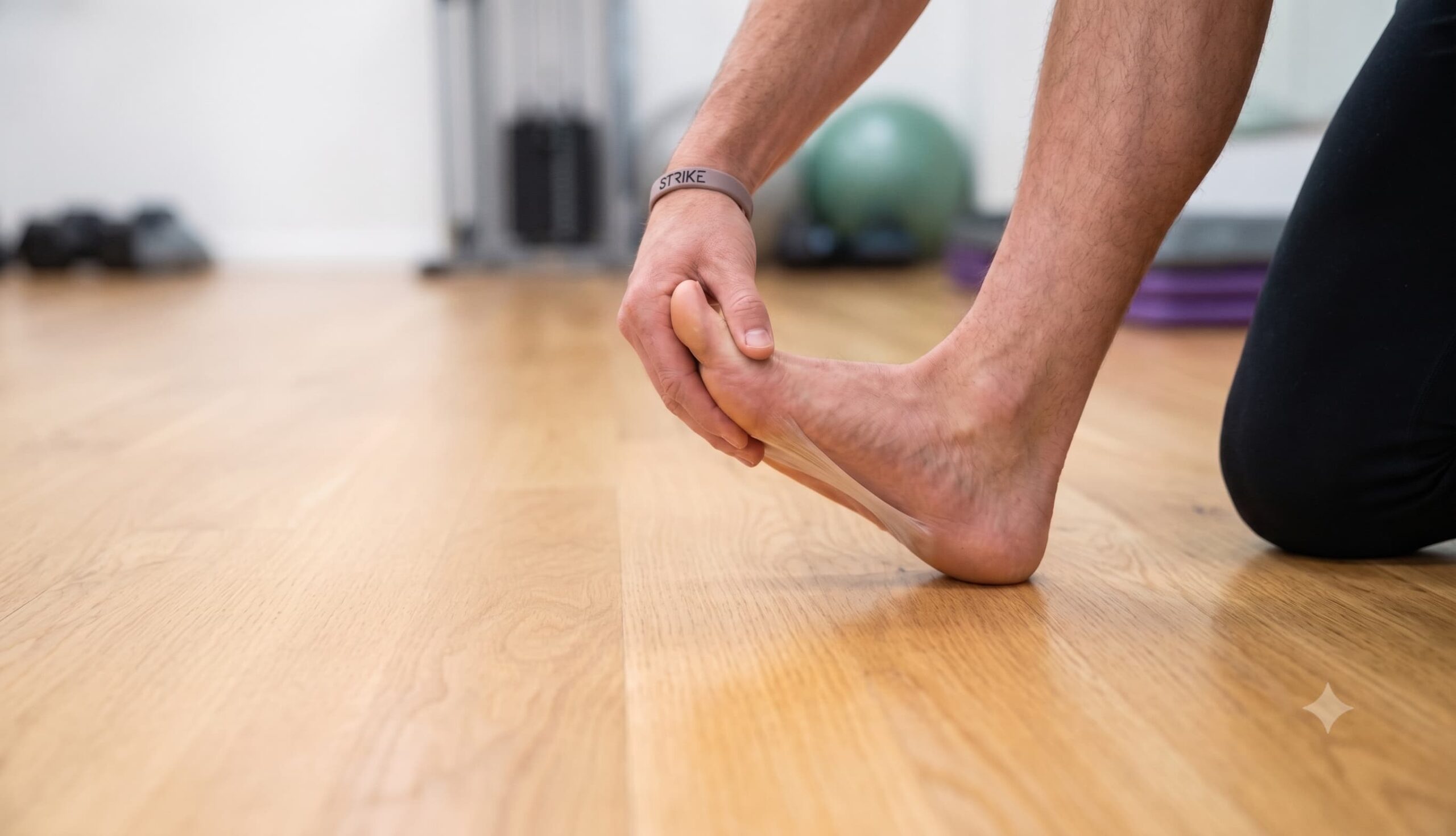
- Calf and plantar fascia stretching. Stretching the calves and plantar fascia is widely considered the most effective way to relieve plantar fasciitis pain. [1][4] Gentle daily calf stretches against a wall make a real difference. For the fascia itself, cross your ankle over the opposite knee and gently pull your toes back toward your shin, holding for 20–30 seconds. Doing this before your first morning steps can take the edge off that classic first-step pain. [1]
- Roll it out. Rolling the arch of your foot over a frozen water bottle or a firm ball for a few minutes gives you both a gentle massage and some cooling relief.
- Fix your footwear. Swap unsupportive shoes for ones with good arch support and cushioning, and avoid walking barefoot on hard floors — even at home. This one change is often underrated.
- Respect the load, don’t just rest. Complete rest usually isn’t the whole answer, because the tissue needs some loading to heal and strengthen. Instead, dial your activity back to a level that doesn’t spike your pain, then rebuild gradually. Low-impact options like cycling or swimming let you stay active while you recover. [1]
When to get professional help
Plantar fasciitis can be stubborn. If you’ve genuinely tried the above for a few weeks and you’re not steadily improving — or the pain is limiting your work, training, or daily life — that’s the point to bring in a professional rather than white-knuckling it for months. The longer a case drags on, the more it tends to become chronic, so earlier is better.
Get assessed sooner if the pain is severe, it’s in both feet, it followed a specific injury, there’s numbness or tingling, or it simply isn’t fitting the typical pattern. A proper assessment also rules out other causes of heel pain (like a stress fracture or a nerve issue) that need different treatment.
How we approach plantar fasciitis at Strike Recovery
The advantage of a clinic-based approach is that a practitioner can assess your specific drivers — foot mechanics, calf flexibility, footwear, training load — and combine treatments that work better together than any one does alone. A typical plan might include:
- Manual therapy to release tight calf, foot and lower-leg tissues that are feeding the problem.
- A loading and strengthening program — often the part people skip on their own, and frequently what creates lasting change. Progressive calf and foot strengthening rebuilds the tissue’s capacity to handle load.
- Custom orthotics — for feet whose mechanics are a major driver, a custom-fit insole can offload the fascia and support the arch through your day.
- Shockwave therapy (ESWT) — for chronic cases that haven’t responded to first-line care, this is one option we may discuss. We’ll be straight with you about the evidence: study results are mixed — some show a modest benefit for long-standing plantar heel pain, while others (including guidance from the American Academy of Orthopaedic Surgeons) note the overall evidence is inconsistent. [1][2][3] That’s exactly why we reserve it for stubborn cases rather than treating it as a first step or a guaranteed fix.
The goal isn’t just to calm today’s pain — it’s to address why it started so it doesn’t come straight back the moment you return to normal activity.
How long does recovery take?
Honest answer: it varies, but the outlook is good. The American Academy of Orthopaedic Surgeons notes that more than 90% of people improve within about 10 months of starting simple treatment. [1] Many who catch it early and address the causes feel significantly better well within that window. Chronic cases that have been building for a long time take more patience. The single biggest factor in slow recovery is usually leaving it too long before changing anything — so if you take one thing from this article, let it be don’t just wait it out for a year hoping it fades.
Frequently asked questions
Can I keep running with plantar fasciitis? Sometimes, at a reduced level — but pushing through sharp pain usually prolongs things. A physiotherapist can help you find the load your foot can currently tolerate and build back up safely.
Do I need a referral to be seen? For physiotherapy, chiropractic and massage therapy in BC, you generally don’t need a doctor’s referral (some insurance plans and ICBC claims are exceptions — check with your provider).
Will insurance cover my treatment? We direct-bill the majority of insurance providers, as well as ICBC and WorkSafe BC, so in most cases you won’t pay the full price out of pocket at your visit.
Are heel spurs the same thing? No. A heel spur is a small bony growth that sometimes shows up alongside plantar fasciitis, but it’s usually not the actual source of the pain — the irritated fascia is. [1]
Get back on your feet
Morning heel pain is common, but it’s not something you just have to live with. The sooner you address the causes, the faster and more completely it tends to resolve.
If you’re in the North Burnaby area and your heel pain isn’t budging, our team can assess what’s driving it and build you a plan to fix it — combining hands-on treatment, a targeted exercise program, and other options where they’ll genuinely help.
Ready to get moving again? Book online or give us a call.
A note on this article
This article is provided for general educational purposes only and is not a substitute for professional medical advice, diagnosis, or treatment. Everybody is different — before starting new exercises or treatments, especially if you have significant pain, an existing injury, or a medical condition, consult a qualified healthcare professional. If your pain is severe, rapidly worsening, or accompanied by numbness, swelling, or an inability to bear weight, seek prompt medical care.
References
- American Academy of Orthopaedic Surgeons (OrthoInfo). Plantar Fasciitis and Bone Spurs. https://orthoinfo.aaos.org/en/diseases–conditions/plantar-fasciitis-and-bone-spurs/
- Systematic review with meta-analysis on the efficacy and tolerability of extracorporeal shock wave therapy (ESWT) in plantar fasciopathy (2024). https://pubmed.ncbi.nlm.nih.gov/39257331/
- Systematic review and meta-analysis: effectiveness of ESWT for plantar heel pain (found a statistically significant but small effect). https://www.ncbi.nlm.nih.gov/pmc/articles/PMC1097736/
- Randomized study on a gastrocnemius-soleus stretching program as treatment for chronic plantar fasciitis (2022). https://www.ncbi.nlm.nih.gov/pmc/articles/PMC8956500/