

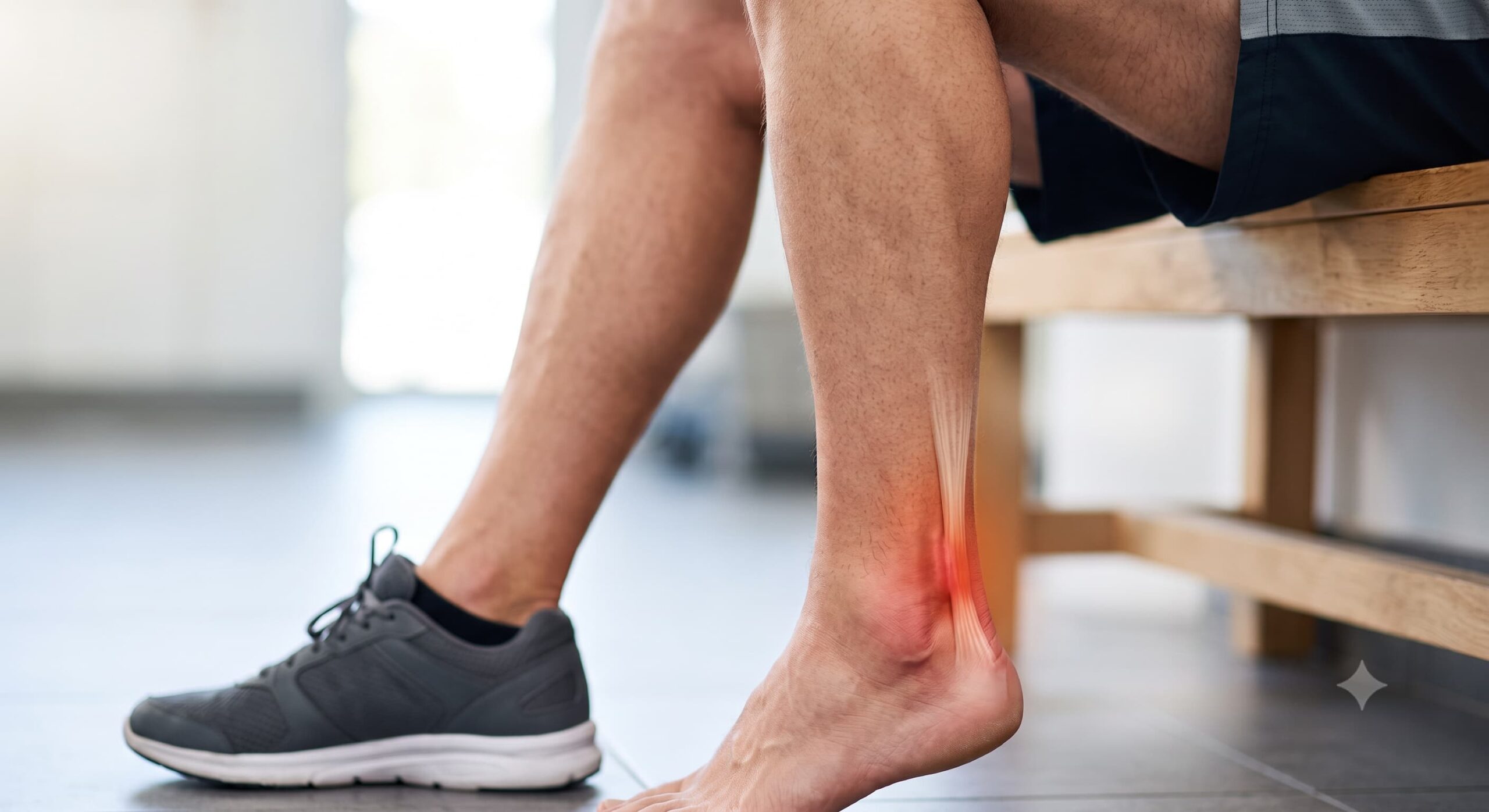
Achilles Tendinopathy in Endurance Runners: Stiff Mornings and Loading Fixes
Important Disclaimer: The information provided in this article is for educational and informational purposes only and does not constitute direct medical advice. Achilles tendon pain can range from mild irritation to a partial or full-thickness tear. Always consult with a licensed healthcare practitioner or medical doctor for a proper clinical diagnosis and personalized treatment plan before beginning any physical rehabilitation program.
Achilles Tendinopathy in Endurance Runners: Stiff Mornings and Loading Fixes
If you are a dedicated distance runner, a triathlete, or a functional fitness athlete, you know your body is going to ache after a heavy training block. A little muscle soreness is the price of admission for building endurance and speed. But there is a very specific type of morning stiffness that should immediately trigger your internal warning system.
You wake up, swing your legs out of bed, and take your first step toward the bathroom. Instantly, a sharp, crippling stiffness seizes the back of your heel. You find yourself hobbling or tip-toeing like you have aged forty years overnight. But strangely, after ten or fifteen minutes of walking around the kitchen, the tendon slowly warms up, the stiffness fades, and you feel almost completely normal again.
You might even be able to go for a run later that day with minimal discomfort—until the next morning, when the agonizing cycle repeats itself, slightly worse than the day before.
This classic, textbook presentation is the hallmark of Achilles Tendinopathy.
For athletes seeking achilles tendonitis treatment in Burnaby, the most dangerous thing you can do is ignore this morning stiffness. The Achilles is the thickest, strongest tendon in the human body, but when it begins to structurally fail, it can sideline an athlete for months—or even years—if mismanaged.
In this comprehensive guide, we will break down the anatomy of your body’s ultimate biological spring, explain why “tendonitis” is actually the wrong diagnosis, debunk the myth of complete rest, and outline the exact heavy-loading protocols our multidisciplinary clinic uses to permanently eliminate runner achilles pain.
Anatomy of the Achilles: The Ultimate Biological Spring
To understand how to heal your heel pain, you first need to understand the immense mechanical forces your lower leg absorbs during a run.
The Achilles tendon is a massive, thick cable of fibrous connective tissue located at the back of your lower leg. It serves as the vital anchor point connecting your two major calf muscles—the superficial gastrocnemius and the deep soleus—directly to your heel bone (the calcaneus).
When you run, your Achilles does not just pull your foot downward; it acts as a highly specialized, heavy-duty biological pogo stick. As your foot strikes the ground, your Achilles tendon stretches, absorbing the impact and storing a massive amount of kinetic energy. As you push off your toes to take your next stride, the tendon rapidly recoils, releasing that stored energy to propel you forward.
This mechanism is incredibly efficient, but it comes at a cost. During a standard run, your Achilles tendon is subjected to a load equivalent to six to eight times your total body weight with every single step. If you run a 10K, that tendon absorbs that massive multiplier thousands of times in a row.
When your training volume, running biomechanics, and recovery are perfectly balanced, the tendon adapts to this stress by laying down thicker, stronger collagen fibers. But when the mechanical load exceeds the tissue’s capacity to repair itself, the biological spring begins to break down.
The “-Itis” vs. “-Osis” Myth: Why It Is Not Just Inflammation
For decades, runners with heel pain were diagnosed with “Achilles Tendonitis.” The suffix “-itis” implies that the condition is driven by active, acute inflammation. Consequently, doctors told patients to aggressively ice the tendon, take heavy doses of non-steroidal anti-inflammatory drugs (NSAIDs) like ibuprofen, and rest until the swelling went down.
There is just one massive problem with this approach: clinical research has proven that chronic Achilles pain is rarely an inflammatory condition.
If you have been dealing with this stiffness for more than a few weeks, the acute inflammation is long gone. Instead, the condition has entered a state of cellular degeneration known as tendinosis (which falls under the broader umbrella term of tendinopathy).
The Spaghetti Analogy: Understanding Tendon Degeneration
A healthy Achilles tendon is made up of dense, tightly packed Type I collagen fibers that run perfectly parallel to each other. Imagine a box of uncooked spaghetti noodles—strong, organized, and capable of handling immense linear tension.
When you continually overload the tendon without adequate recovery, the body fails to repair the micro-damage correctly. Instead of laying down neat, parallel fibers, the body panics and lays down disorganized, chaotic Type III collagen. The injured section of the tendon begins to look like a bowl of cooked, tangled spaghetti.
This degenerated tissue is physically thicker (which is why you might feel a visible “bump” or nodule on your Achilles), but it is incredibly weak, functionally useless, and highly sensitive to pain. Because there is no active inflammation to fight, taking ibuprofen will do absolutely nothing to reorganize those collagen fibers.
The Danger of Complete Rest: Why Your Tendon is Starving
When runners feel a sharp pain in their Achilles, their first instinct is often to completely stop running, put their foot in a walking boot, or sit on the couch for a month.
From a clinical rehabilitation standpoint, complete, passive rest is one of the worst things you can do for a degenerating tendon.
Tendons are avascular, meaning they have a notoriously poor blood supply compared to your muscles. They do not get a constant, free-flowing delivery of oxygen and nutrients. Instead, they rely on a process called mechanotransduction. They literally require mechanical tension and movement to “pump” fluids and biological repair agents in and out of the tissue.
If you completely immobilize your Achilles tendon for four weeks, you are starving it.
- The healthy collagen fibers begin to rapidly degrade due to a lack of use (a phenomenon known as stress shielding).
- The calf muscles (gastroc and soleus) rapidly atrophy and lose their strength.
- The tendon becomes even stiffer and more disorganized.
When you finally feel “rested” and decide to go for a light 5K run, the tendon is now significantly weaker than it was before you took a break. It immediately flares up, re-tears, and sends you right back to square one.
Tendons do not heal through passive rest. They heal through precise, progressive, and heavy mechanical loading.
The Biomechanical Root Causes: Why Did Your Achilles Fail?
Achilles tendinopathy rarely happens by accident. It is an overuse injury driven by a specific failure in your training load or your kinetic chain. To permanently cure the pain, our clinicians must identify what caused the overload in the first place.
1. The “Too Much, Too Soon” Training Spike
Your cardiovascular engine (your heart and lungs) adapts to aerobic exercise much faster than your tendons adapt to mechanical stress. You might easily have the cardio capacity to ramp up your long run from 10km to 18km in a single week, but your Achilles tendon requires months to build the structural density to handle that jump. Sudden spikes in weekly mileage, or suddenly adding high-intensity track sprints and hill repeats, are the leading triggers for tendinopathy.
2. Transitioning to Zero-Drop or Carbon-Plated Shoes
Modern running footwear has a massive impact on your lower leg mechanics.
- Zero-Drop Shoes: If you run in a traditional shoe with a 10mm heel drop, your Achilles is accustomed to a shortened range of motion. If you suddenly switch to a minimalist or “zero-drop” shoe, your heel sits lower to the ground. This instantly subjects the Achilles to a massive, unfamiliar stretch under maximum load, often triggering acute tendinopathy.
- Carbon Super-Shoes: High-stack, carbon-plated racing shoes act like a fulcrum. While they are incredibly fast, they often shift the biomechanical workload away from the knee and directly onto the calf and Achilles complex.
3. Weakness in the Soleus Muscle
The calf is made of two main muscles. The gastrocnemius is the large, visible muscle that crosses the knee. The soleus is the deep, powerhouse muscle that sits underneath it and does not cross the knee. During a run, the soleus actually absorbs and generates significantly more force than the gastroc. If your soleus is weak, the entire shock-absorption system fails, and the raw kinetic force is transferred directly into the Achilles tendon.
4. Overstriding and Low Cadence
If your running cadence (steps per minute) is low, you are likely overstriding. Landing with your foot far out in front of your body increases your ground contact time and forces the Achilles tendon to absorb a massive, prolonged eccentric braking force with every single step.
The Strike Recovery Treatment Protocol: Rebuilding the Spring
Fixing a degenerated Achilles tendon is a process of structural remodeling. It requires patience, discipline, and a highly specific loading strategy. You cannot simply stretch your calves and hope for the best.
At Strike Recovery & Performance, our multidisciplinary team utilizes a collaborative, science-backed approach to break down the disorganized scar tissue and force the tendon to rebuild itself stronger than before.
1. Controlling Acute Pain with Isometric Loading (Physiotherapy)
If your tendon is highly reactive—meaning it hurts just to walk up a flight of stairs—we do not start with heavy lifting. We start with Isometric Holds. You will perform a double-leg or single-leg calf raise, lift your heels off the ground, and hold that static position for 45 seconds without moving. You repeat this for 4 to 5 sets. Isometrics are a clinical superpower for tendons. They safely introduce heavy mechanical tension without the damaging friction of movement. More importantly, isometric holds create a profound analgesic (pain-relieving) effect, physically altering how the nervous system interprets the pain signals from the tendon for hours after the exercise.
2. The Heavy Slow Resistance (HSR) Protocol
Once the acute reactivity calms down, we begin the remodeling phase. For years, the gold standard for Achilles rehab was the Alfredson Protocol (doing hundreds of eccentric-only heel drops). However, modern clinical evidence heavily favors Heavy Slow Resistance (HSR) training.
Using a Smith machine, leg press, or heavy dumbbells, a Kinesiologist will guide you through calf raises using very heavy weight at a very slow tempo (e.g., 3 seconds up, 3 seconds down).
- Straight-Leg Calf Raises: This targets the superficial gastrocnemius muscle.
- Bent-Knee / Seated Calf Raises: This completely isolates the deep soleus muscle, which is absolutely critical for endurance runners.
Lifting heavy weights slowly sends a mechanical signal to the tendon cells (tenocytes) to clear out the chaotic, cooked-spaghetti collagen and lay down thick, highly organized, parallel Type I collagen fibers. This physically thickens and stiffens the tendon, increasing its ultimate load capacity.
3. Advanced Modalities: Extracorporeal Shockwave Therapy
For chronic, stubborn Achilles tendinopathy that has persisted for over three months, our clinic utilizes Extracorporeal Shockwave Therapy. A clinician directs high-energy acoustic soundwaves straight into the degenerated nodule on the Achilles. These soundwaves cause controlled micro-trauma, physically breaking apart disorganized scar tissue and calcifications. Crucially, shockwave therapy triggers neovascularization—the growth of brand new blood vessels—flooding the starving, avascular tendon with fresh oxygen and healing nutrients to restart the stalled recovery process.
4. Neuromuscular Soft Tissue Release (Registered Massage Therapy)
While we never aggressively massage the injured tendon itself (which only aggravates it), our Registered Massage Therapists play a vital role in recovery by treating the muscular engine above it. When the Achilles is in pain, the gastrocnemius and soleus muscles lock into a chronic, hypertonic spasm to guard the tendon. Our RMTs utilize deep myofascial release, instrument-assisted soft tissue mobilization (IASTM), and trigger point therapy to release these massive calf muscles. By softening the muscle belly, we instantly reduce the upward pulling tension on the Achilles anchor point at the heel.
5. Joint Mechanics and Gait Retraining (Chiropractic Care & Kinesiology)
An Achilles tendon will never heal if your foot mechanics are constantly torturing it.
- Our Chiropractors will assess your ankle for restrictions. If your ankle (talocrural joint) lacks dorsiflexion mobility, your foot will forcefully overpronate to compensate, whipping the Achilles side-to-side (a “bowstring” effect) with every step. Specific joint adjustments restore symmetrical tracking.
- Our Kinesiologists will perform a treadmill gait analysis, implementing cadence manipulations (increasing your step rate by 5-10%) to instantly shorten your stride, pull your foot strike under your center of mass, and drastically reduce the mechanical braking load on the tendon.
The Plyometric Bridge: Returning to the Road
The biggest mistake runners make in rehab is going straight from slow, heavy calf raises in the gym to a 10K run on the pavement.
Slow resistance training builds the strength of the tendon, but running requires the tendon to act as a high-velocity spring. Before you return to running, you must bridge this gap with a structured plyometric phase.
We safely expose the Achilles to explosive, fast-stretch shortening cycles. You will progress from double-leg pogo hops to single-leg bounding and jump rope intervals. This trains the tendon to store and release kinetic energy rapidly without failing. Only once you can complete these explosive drills completely pain-free do we graduate you to a structured, walk-run return protocol.
Don’t Let Morning Stiffness Snap Your Tendon
Achilles tendinopathy is not a condition you can out-stubborn. If you try to run through the morning stiffness, masking the pain with ibuprofen and ignoring the warning signs, the cellular degeneration will worsen. Over time, the structural integrity of the biological cable will become so compromised that a sudden sprint or a misstep off a curb can result in a catastrophic, full-thickness Achilles rupture—an injury that guarantees surgical repair and a grueling, year-long recovery.
Do not let a treatable overuse injury end your racing season. Stop resting on the couch, stop stretching a dying tendon, and start actively rebuilding your tissue capacity.
By combining advanced diagnostics, heavy slow resistance training, shockwave therapy, and expert manual release, you can completely remodel your Achilles tendon and return to the road with a stronger, more resilient stride.
Are you tired of hobbling out of bed every morning? Don’t wait for the tendon to fail. Head to our booking portal and schedule a comprehensive lower-limb assessment with the expert multidisciplinary team at Strike Recovery & Performance in Burnaby today.
References:
- Cook, J. L., & Purdam, C. R. “Is tendon pathology a continuum? A pathology model to explain the clinical presentation of load-induced tendinopathy.” British Journal of Sports Medicine.
- Beyer, R., et al. “Heavy Slow Resistance Versus Eccentric Training as Treatment for Achilles Tendinopathy: A Randomized Controlled Trial.” The American Journal of Sports Medicine.
- Rio, E., et al. “Isometric exercise induces analgesia and reduces inhibition in patellar tendinopathy.” British Journal of Sports Medicine. (Note: Principles of isometric analgesia apply directly to the Achilles).
- Mani-Babu, S., et al. “The effectiveness of extracorporeal shock wave therapy in lower limb tendinopathy: a systematic review.” The American Journal of Sports Medicine.
- Silbernagel, K. G., et al. “Current Clinical Concepts: Conservative Management of Achilles Tendinopathy.” Journal of Athletic Training.