

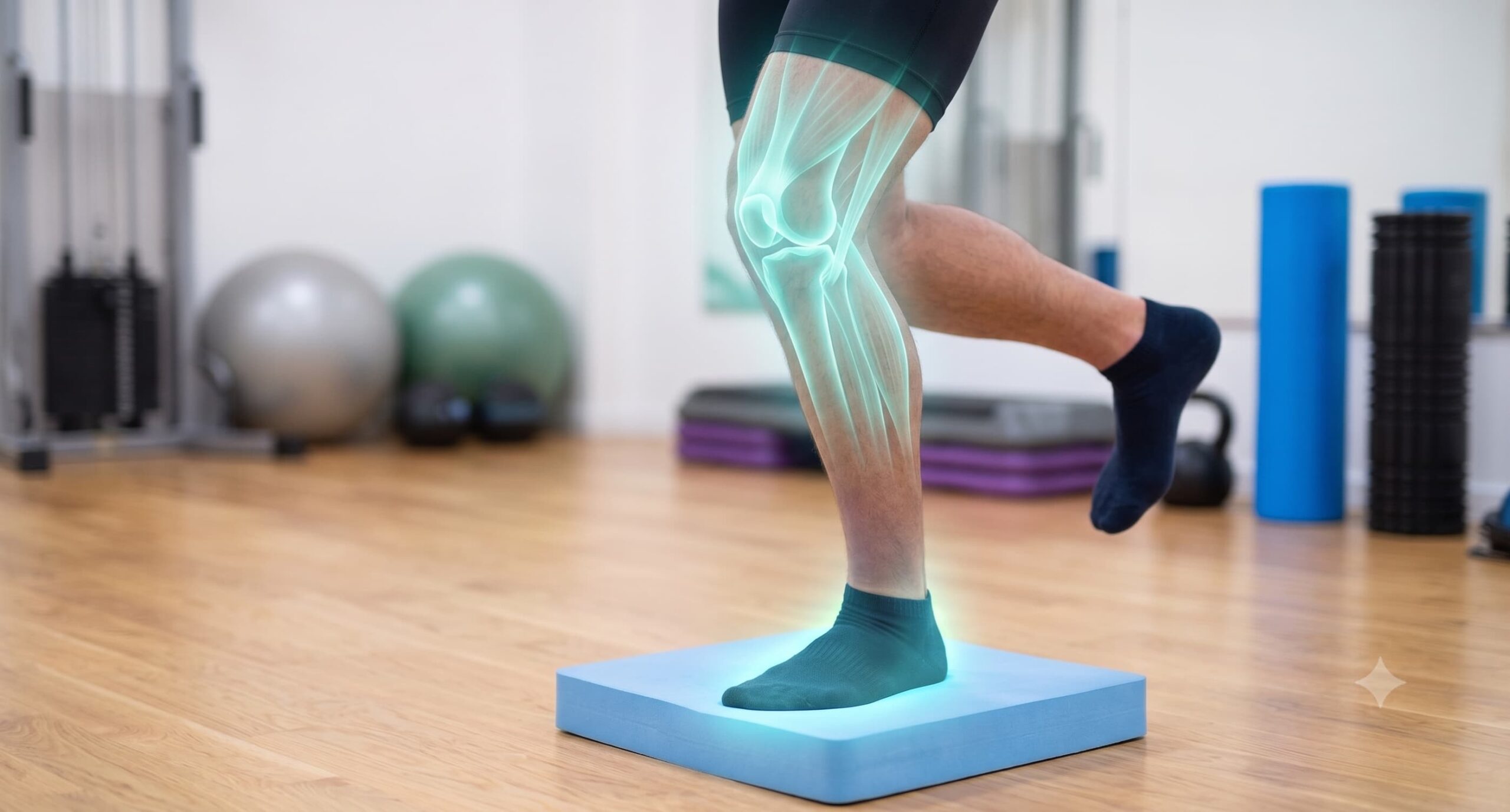
Patellar Tendinopathy: Catching Anterior Knee Pain Early in Lifters
Important Disclaimer: The information provided in this article is for educational and informational purposes only and does not constitute direct medical advice. Knee pain can stem from various structural issues, including ligament tears and meniscus damage. Always consult with a licensed healthcare practitioner for a proper clinical diagnosis and personalized treatment plan before beginning any physical rehabilitation program.
Patellar Tendinopathy: Catching Anterior Knee Pain Early in Lifters
Patellar Tendinopathy: Catching Anterior Knee Pain Early in Lifters
You’re squatting heavy, and there’s a sharp ache right at the base of your kneecap. It’s not unbearable—you can still move through it—but it’s there. You ignore it for a few sessions. Then a few weeks pass. Suddenly the pain is worse, your squat depth is limited, and you’re questioning whether you can keep lifting.
This is patellar tendinopathy in its early stages. Catch it now, and you can fix it while still training. Ignore it, and you’re looking at months of severely limited lower-body work. Understanding this injury, why it happens, and how to address it is worth the few minutes to read this.
What Is Patellar Tendinopathy?
Your patellar tendon connects your kneecap (patella) to your shinbone (tibia). It’s under enormous tension every time you squat, jump, or load your leg. In lifters doing heavy squats, this tendon faces demands that sometimes exceed its capacity, leading to micro-damage and inflammation.
Here’s what’s important: patellar tendinopathy isn’t an acute injury. It develops gradually through repetitive loading without adequate recovery or progression. You don’t wake up with it; it builds over weeks or months of training.
Why this matters for lifters: Unlike an acute tear, tendinopathy is about load tolerance. Your tendon doesn’t need to heal so much as it needs to be loaded progressively to rebuild resilience. The right loading plan makes it stronger. Rest alone usually doesn’t work.
How to Recognize Patellar Tendinopathy Early
Early Signs (Weeks 1-4)
- Sharp ache at the base of the kneecap, worse during heavy squats or loaded leg work
- Pain that eases with warmup but returns during hard sets
- Stiffness in the morning that improves with movement
- Pain only during specific movements (heavy squats, jump squats) but not others
Mid-Stage Signs (Weeks 4-8, If Ignored)
- Pain gets worse, not better, with more training
- Pain begins affecting lighter movements—even bodyweight squats hurt
- Stiffness that doesn’t improve much with warmup
- Pain after training that lingers into the next day
- Visible swelling or puffiness below the kneecap
Late Stage (Months, If Severely Ignored)
- Chronic pain with almost any knee-bending activity
- Significant squat depth limitation or inability to squat at all
- Pain affecting daily life—stairs become difficult, sitting becomes uncomfortable
The key is catching this early. Most lifters can manage patellar tendinopathy in the early stage with smart training modifications. Wait until late stage, and you’re looking at weeks or months of essentially no lower-body training.
Why Lifters Get Patellar Tendinopathy
Rapid Volume Increase
You added a new squat accessory. You started running lower-body hypertrophy work. You increased squats from 2x to 3x per week. Any of these increases can push your patellar tendon beyond its capacity, especially if the increase is quick (>10% per week).
Inadequate Load Management
Your tendon can handle progressive load, but only if the progression is appropriate. Jumping from 315 lbs to 365 lbs too quickly, or ramping up set volume without allowing adaptation, exceeds the tendon’s tolerance.
Poor Recovery Between Sessions
Tendon adaptation happens during recovery, not during training. Two heavy leg days back-to-back, without adequate sleep, nutrition, and recovery days, doesn’t give the tendon time to adapt to the load.
Weak Quadriceps or Hip Stabilizers
Your muscles support your tendon. If your quads are undertrained relative to the loads you’re moving, or if your hip stabilizers are weak (causing knee valgus in the squat), the tendon handles more load than it should.
The Right Training Approach: Progressive Tendon Loading
Here’s the critical insight: resting a patellar tendon doesn’t make it stronger. Progressive loading makes it stronger. The right approach balances adequate challenge with appropriate recovery.
Phase 1 (Weeks 1-3): Identify the specific movements that provoke pain. Back off those movements or load slightly. Introduce isometric loading (sustained holds) which signals the tendon to adapt without the movement irritation. Example: isometric squat holds at 50% depth, progressing to deeper holds.
Phase 2 (Weeks 4-6): Begin eccentric loading (slow lowering). Heavy eccentric loading is the most effective way to rebuild tendon resilience. Example: load slightly heavier than normal, lower very slowly (3-4 seconds) into the squat, then use assistance to return to top. This loads the tendon maximally while you’re strongest.
Phase 3 (Weeks 7-10): Progressive return to normal squatting. As tolerated, reintroduce full-range, concentric-eccentric loading (normal squat movement). Load increases gradually as pain decreases.
Phase 4 (Weeks 10+): Return to normal training, but with permanent load management principles: gradual progression, adequate recovery days, balanced quad/hip training.
Practical Training Modifications You Can Make Now
- Reduce squat frequency temporarily: From 3x to 2x per week if pain is present. This removes one loading cycle per week, giving more recovery time.
- Reduce volume initially: Do fewer sets of squats while pain is present. You’re not giving up training; you’re protecting the tendon while maintaining strength.
- Modify loading direction: If traditional squats hurt, try rack positions that reduce patellar tendon load. Front-loaded variations (front squat, goblet squat) often hurt less than back squats initially.
- Add quad-strengthening work: Bulgarian split squats, leg extensions, and quad-focused accessory work strengthen muscles that support the tendon.
- Improve hip stability: Copenhagen adductors, side-lying hip abduction, and glute work reduce compensatory stress on the knee.
- Include recovery days between legs: At least 48 hours between heavy lower-body sessions. Tendon adaptation happens between sessions, not during them.
Why “Just Rest” Doesn’t Work Long-Term
Many lifters try complete rest for patellar tendinopathy. For 2-3 weeks, pain improves because the tendon isn’t being loaded. But as soon as they return to training, pain comes back—sometimes worse. Why? Because the tendon hasn’t been progressively loaded to handle training demands again.
Progressive loading—starting with manageable load and gradually increasing—is what actually fixes the problem long-term. It’s slower than complete rest initially but leads to real recovery and training return.
When to Seek Professional Help
If you have anterior knee pain lasting more than 2 weeks, or if the strategies above aren’t reducing pain within 3-4 weeks, see a physiotherapist. They can:
- Confirm patellar tendinopathy (vs. other knee issues)
- Design a specific loading program for your current capacity
- Identify movement pattern issues (like knee valgus) contributing to the problem
- Monitor progression and adjust loading appropriately
Anterior knee pain limiting your training? Don’t wait for it to get worse. Our physiotherapists specialize in sports injuries and training-related pain. Get assessed now and get a loading-based plan to get you back to heavy squats.
Medical Disclaimer
This blog post is for informational purposes only. It describes general patterns of patellar tendinopathy and is not a diagnosis or treatment plan for your specific situation. Anterior knee pain can have many causes. See a physiotherapist or physician for proper assessment before modifying your training.
Sources & References
- Littlewood, C., Ashton, J., Chance-Larsen, K., May, S., & Sturrock, B. (2012). Exercise for rotator cuff tendinopathy: A systematic review. Physiotherapy, 98(2), 101-109.
- Knobloch, K., Gøtzold, A., Krauspe, R., & Vogt, P. M. (2006). Eccentric training in Achilles tendinopathy. American Journal of Sports Medicine, 34(2), 268-273.
- Rio, E., Moseley, G. L., Purdam, C., et al. (2014). The pain of tendinopathy: Physiological or pathophysiological? Sports Medicine, 44(1), 9-23.
- Malliaras, P., Barton, C. J., Reeves, N. D., & Langberg, H. (2013). Achilles and patellar tendinopathy loading programmes. Sports Medicine, 43(4), 267-286.
- Kongsgaard, M., Aagaard, P., Roikjaer, S., Olsen, D., Jensen, M., Langberg, H., & Magnusson, S. P. (2006). Decline sit-ups exercise: Biomechanics and effectiveness. Scandinavian Journal of Medicine & Science in Sports, 16(1), 57-65.
- Gatteschi, L., Assi, R., El-Kadi, T., et al. (2013). Eccentric training: Physiological and structural adaptations. Journal of Sports Science & Medicine, 12(1), 1-11.
- Lysholm, J., & Wiklander, J. (1987). Injuries in runners. American Journal of Sports Medicine, 15(2), 168-171.
- Lorbach, O., Kieb, M., Herbort, M., & Wefers, B. H. (2014). Good outcome for conservative treatment of superior labral anterior-posterior lesions in overhead athletes. Arthroscopy: The Journal of Arthroscopic & Related Surgery, 30(11), 1395-1400.