

ACL Injuries: Prevention Strategies Every Athlete Should Know
Important Disclaimer: The information provided in this article is for educational and informational purposes only and does not constitute direct medical advice. Knee injuries, particularly those involving catching, clicking, or locking of the joint, require professional clinical assessment. Always consult with a licensed healthcare practitioner or medical doctor for a proper clinical diagnosis and personalized treatment plan before beginning any physical rehabilitation program.
ACL Injuries: Prevention Strategies Every Athlete Should Know
An ACL tear can end a season or derail a career. The fear is real for athletes in cutting, pivoting sports: soccer, basketball, football, tennis. But here’s what most people don’t know: ACL injuries aren’t random acts of fate. Most ACL tears happen during non-contact movements—a deceleration, a cut, a landing. And these are largely preventable through smart movement patterns and physical preparation.
Understanding ACL injury mechanisms and how to train defensively against them is worth far more than any brace after the fact.
Why ACL Injuries Happen
The Most Common Mechanism: Non-Contact Deceleration
Most ACL injuries don’t happen when someone takes you down. They happen when you plant your foot to decelerate or change direction, and your knee caves inward (valgus collapse) or your tibia rotates excessively while your foot is fixed to the ground. The ligament tears from this internal rotational stress.
This matters because it means the injury is trainable. You can teach your body how to decelerate and change direction without putting your ACL at risk.
Risk Factors You Can Control
- Weak hip abductors and external rotators: These muscles control knee valgus during landing and deceleration. Weak hips = knee cave = ACL risk.
- Quadriceps-to-hamstring imbalance: Quads are powerful knee extensors; hamstrings decelerate forward knee motion. Weak hamstrings can’t control the deceleration, putting stress on the ACL.
- Poor landing mechanics: Landing with a vertical shin (knee over ankle) and knees bent distributes force through your muscles. Landing with a straight knee and forward lean puts all stress on your ligament.
- Inadequate proprioception and balance: Your nervous system needs to recognize unstable positions instantly and correct them. Poor proprioception means slower reactions to unstable moments.
- Lack of ankle mobility: Limited ankle motion forces your knee and hip to compensate, increasing injury risk during dynamic movement.
- Fatigue: Your movement quality deteriorates when tired. Sloppy landing mechanics and sluggish neuromuscular responses late in games/practices are high-risk moments.
Evidence-Based Prevention: The Essentials
1. Strength Training (Especially Single-Leg)
Multi-directional strength reduces injury risk significantly. Focus on:
Hip strengthening: Copenhagen adductors, side-lying hip abduction, lateral band walks, and step-ups with control. These target the muscles that control knee valgus.
Single-leg balance and loading: Single-leg Romanian deadlifts, single-leg squats, and lateral bounds. These challenge stability dynamically, building proprioceptive control.
Hamstring emphasis: Nordic hamstring curls (eccentric loading at long muscle lengths) and prone stability ball hamstring curls. Strong hamstrings are ACL injury protective.
Quad strength: Traditional squats and leg press. Balanced quad/hamstring strength matters.
Key principle: Train single-leg whenever possible. Double-leg exercises don’t challenge proprioceptive stability the way single-leg work does.
2. Landing Mechanics Training
How you land during jumps or cuts directly determines ACL injury risk. Good landing mechanics involve:
- Knee bend on landing: Land with your knees bent (not straight), distributing force through your leg muscles rather than your ligaments.
- Knee over ankle: When viewed from the front, your knee should stay roughly over your ankle (not caving inward).
- Upright torso: Lean slightly forward from your ankles, not from your waist. Excessive forward lean forces your knee into risky positions.
- Controlled deceleration: Land with control, taking 0.5-1 full second to decelerate rather than landing abruptly and stopping instantly.
These patterns can be trained. Video analysis, mirror feedback, and conscious practice during drills are effective. The more you practice good landing mechanics in controlled settings, the more automatic they become during game situations.
3. Agility and Change-of-Direction Training
Cutting movements involve rapid deceleration and direction change—high-risk moments for ACL injuries. Train this with:
- Planned cutting drills (cones, lane drills) with emphasis on quality technique
- Progressive increase in speed—master the movement pattern at lower speeds before adding intensity
- Varied cutting angles—randomized, unpredictable directions challenge your nervous system to adapt
- Sport-specific drills that mimic game movements
4. Proprioceptive Training
Your proprioceptive system (sense of where your body is in space and how to control it) is trainable. Include:
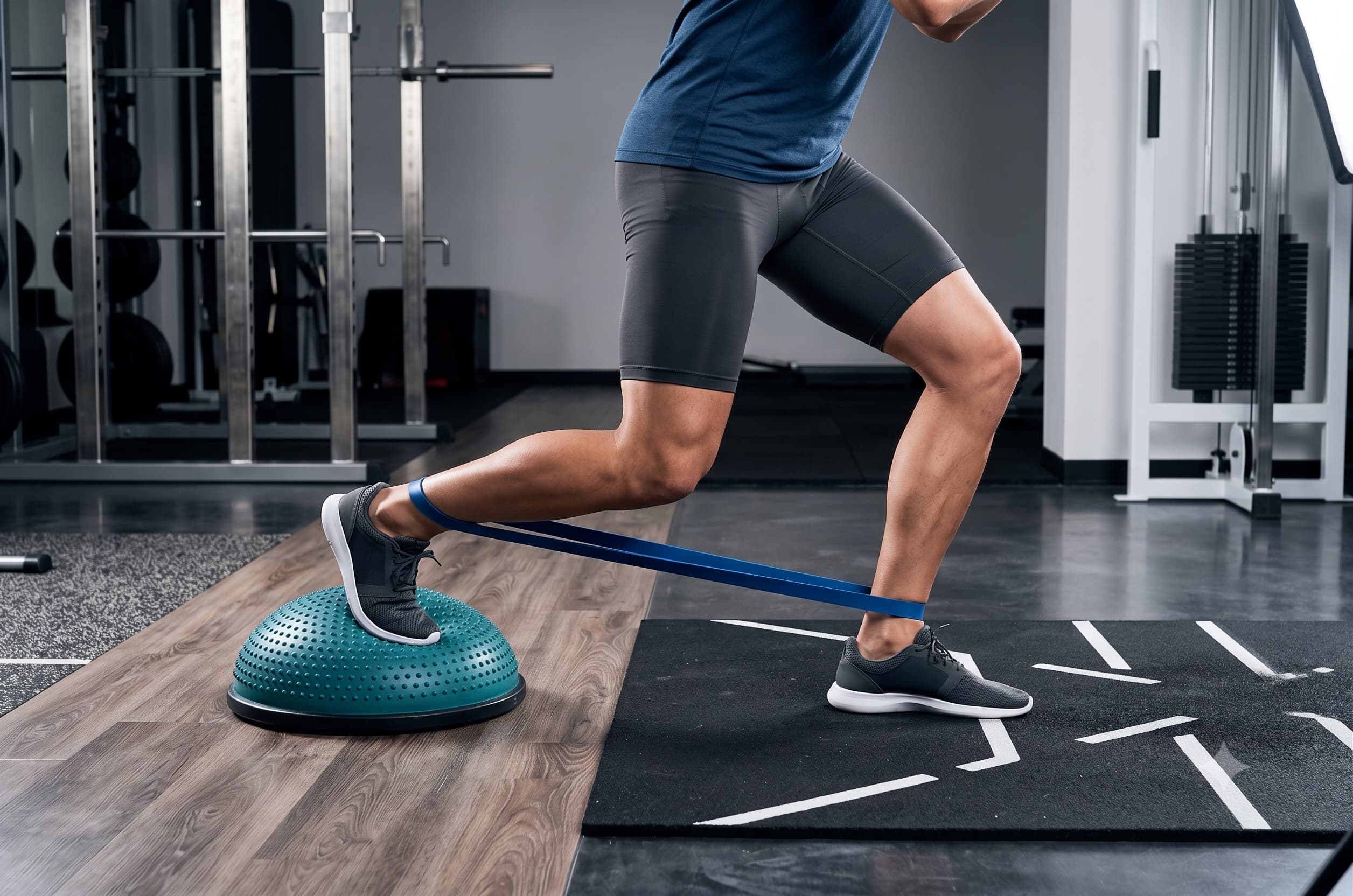
- Balance board or wobble cushion training
- Single-leg stance progressions (with and without upper body movement)
- Eyes-closed balance challenges
- Perturbation training (unpredictable nudges that force quick stabilization)
Practical Prevention Program: What to Do
Frequency: 2-3 times per week, 20-30 minutes per session (can be integrated into regular training)
Strength block (2-3x per week):
- Nordic hamstring curls: 3 sets x 6-8 reps
- Single-leg squats or step-ups: 3 sets x 8 reps each leg
- Copenhagen adductors: 3 sets x 10-15 reps each side
- Lateral band walks: 3 sets x 12 reps each direction
Landing mechanics (1-2x per week):
- Double-leg landings from low height, progressing to higher
- Single-leg landings with control
- Lateral bound-and-stick (rapid lateral movement with controlled deceleration)
- Planned cutting drills at progressive speeds
Why Prevention Programs Work
Multiple research studies show that structured ACL prevention programs reduce injury risk by 50-70%. This is substantial—comparable to many medical interventions. The programs that work combine strength (especially hip and hamstring), landing mechanics training, and proprioceptive challenge.
The time investment is modest. Most effective programs take 20-30 minutes, 2-3 times per week. For an athlete in a sport at risk for ACL injury, this is invaluable insurance.
When Recovery Matters More Than Prevention
If you’ve already had an ACL injury or surgery, prevention principles matter even more. Your re-injury risk is higher than initial injury risk, and your return-to-sport testing should be rigorous. This isn’t the place for guessing. Working with a physiotherapist experienced in ACL rehabilitation and return-to-sport testing is important.
Want to reduce your ACL injury risk or are recovering from an ACL injury? Our physiotherapists specialize in sports injury prevention and ACL rehabilitation. Book a movement assessment to identify your personal risk factors and create a prevention plan tailored to your sport.
Medical Disclaimer
This blog post is for informational purposes only. It describes general ACL injury prevention strategies and is not a personalized injury prevention plan. Every athlete’s injury risk profile is different. A professional movement assessment can identify your specific risk factors and create an appropriate training program.
Sources & References
- Myklebust, G., Engebretsen, L., Brækken, I. H., Skjølberg, A., Olsen, O. E., & Bahr, R. (2003). Prevention of anterior cruciate ligament injuries in female team handball players: A prospective intervention study over three seasons. Clinical Journal of Sport Medicine, 13(2), 71-78.
- Mandelbaum, B. R., Silvers, H. J., Watanabe, D. S., et al. (2005). Effectiveness of a neuromuscular and proprioceptive training program in preventing anterior cruciate ligament injuries in female athletes. American Journal of Sports Medicine, 33(7), 1003-1010.
- Hewett, T. E., Lindenfeld, T. N., Riccobene, J. V., & Noyes, F. R. (1999). The effect of neuromuscular training on the incidence of knee injury in female athletes. American Journal of Sports Medicine, 27(6), 699-706.
- Chimera, N. J., Swanik, K. A., Swanik, C. B., & Straub, S. J. (2004). Effects of plyometric training on muscle-activation strategies and performance in female athletes. Journal of Athletic Training, 39(1), 24-31.
- Paterno, M. V., Schmitt, L. C., Ford, K. R., et al. (2010). Biomechanical measures during landing and postural stability predict second anterior cruciate ligament injury after anterior cruciate ligament reconstruction and return to sport. American Journal of Sports Medicine, 38(10), 1968-1978.
- Myer, G. D., Ford, K. R., Barber Foss, K. D., et al. (2009). The incidence and potential pathomechanics of ACL injuries in female competitive gymnasts. Journal of Athletic Training, 44(4), 410-415.
- Gilchrist, J., Mandelbaum, B. R., Melancon, H., et al. (2008). A randomized controlled trial to prevent noncontact anterior cruciate ligament injury in female collegiate soccer players. American Journal of Sports Medicine, 36(8), 1476-1483.
- Krosshaug, T., Nakamae, A., Boden, B. P., et al. (2007). Mechanisms of anterior cruciate ligament injury in basketball: Video analysis of 39 cases. American Journal of Sports Medicine, 35(3), 359-367.