

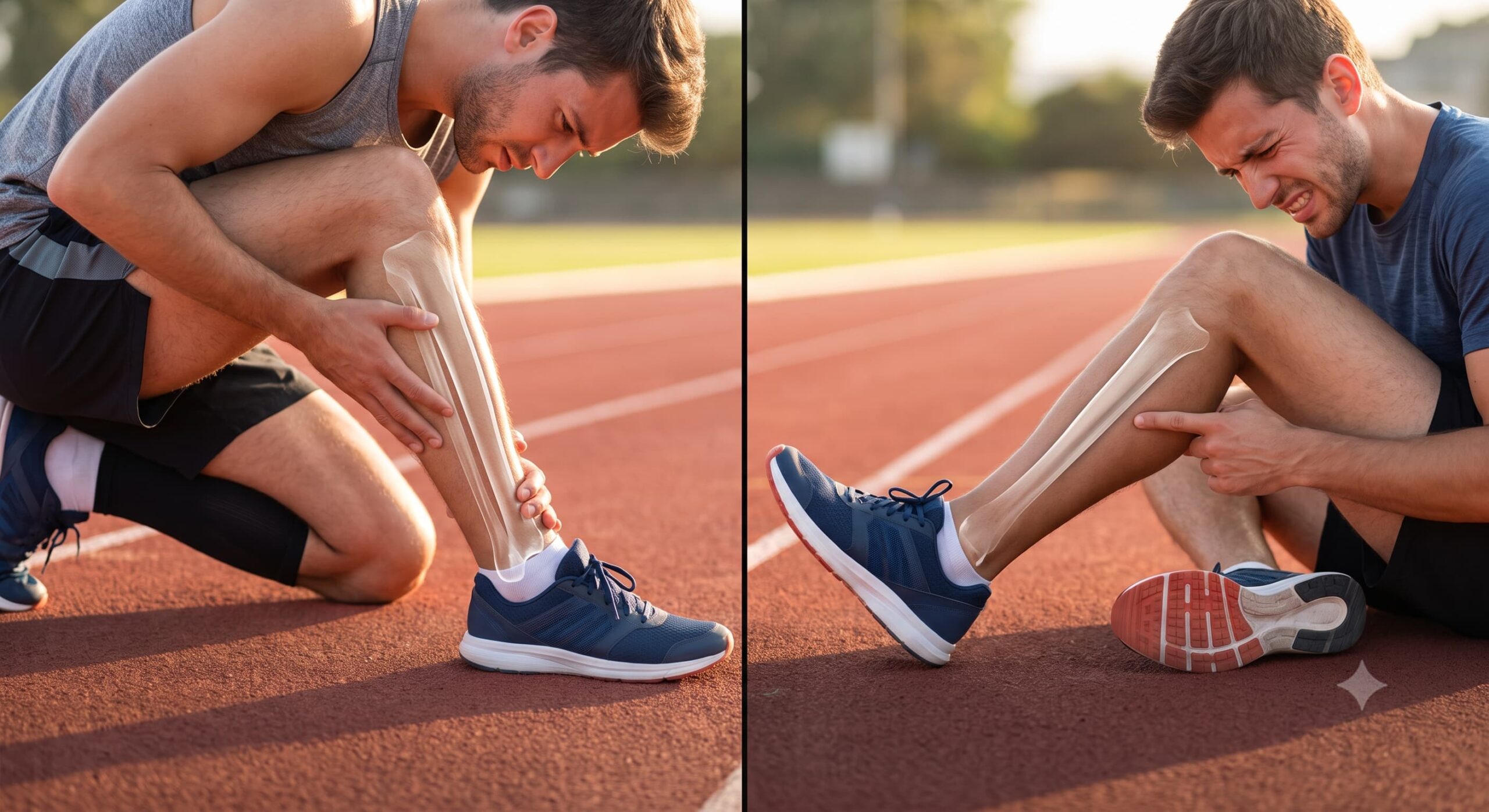
Shin Splints vs. Stress Fractures: Knowing When to Run Through It (And When to Stop)
Important Disclaimer: The information provided in this article is for educational and informational purposes only and does not constitute direct medical advice. Lower leg injuries can range from mild inflammation to severe bone fractures. Always consult with a licensed healthcare practitioner or medical doctor for a proper clinical diagnosis and personalized treatment plan before beginning any physical rehabilitation program.
Shin Splints vs. Stress Fractures: Knowing When to Run Through It (And When to Stop)
For endurance athletes, there is nothing quite as frustrating as a lower leg injury. Whether you are logging easy, restorative miles around Burnaby Lake or grinding through your peak training weeks in preparation for upcoming local races like the Vancouver Half Marathon, your lower legs absorb an immense amount of mechanical force. Every single time your foot strikes the pavement, your body is forced to manage a ground reaction force equal to two or three times your total body weight.
When things go perfectly, your muscles, tendons, and bones adapt to this stress, becoming denser and stronger. But when the volume, intensity, or biomechanics are slightly off, that repetitive stress quickly turns destructive.
The most common consequence of this mechanical overload is a deep, nagging ache on the front or inside of your lower leg. For most runners, the immediate assumption is “shin splints.” They try to stretch their calves, buy a new pair of shoes, and attempt to push through the discomfort. But what happens when that ache isn’t just a simple muscle strain? What happens when it is a structural failure of the bone itself?
Understanding the clinical difference between Medial Tibial Stress Syndrome (shin splints) and a Tibial Stress Fracture is critical. Treating a stress fracture like a simple case of shin splints can result in a catastrophic, full-thickness bone break that requires surgical intervention and months of forced rest.
If you are looking for evidence-based shin splints treatment in Burnaby, or if you are worried about recognizing tibial stress fracture signs, this comprehensive guide will break down the anatomy of lower leg pain, the diagnostic tests we use to tell them apart, and how our multidisciplinary team keeps runners on the road.
What Are Shin Splints (Medial Tibial Stress Syndrome)?
The term “shin splints” is a broad, non-medical catch-all phrase that the general public uses to describe pain on the front of the lower leg. In the sports medicine and clinical rehabilitation world, we refer to the most common presentation of this pain as Medial Tibial Stress Syndrome (MTSS).
MTSS is characterized by a diffuse, generalized ache along the inner border of the tibia (the large shin bone). To understand why this happens, you have to look at how the muscles of the lower leg attach to the bone.
Your soleus (the deep calf muscle) and your tibialis posterior (a muscle responsible for supporting the arch of your foot) run down the back and inside of your leg. These muscles do not just float in space; they are firmly anchored to the periosteum—a thin, tough, fibrous membrane that wraps entirely around the outside of your tibia.
When you run, these muscles contract forcefully to push you forward and eccentrically lengthen to absorb the shock of landing. If your foot overpronates (collapses inward), or if your calves are incredibly tight, these muscles pull aggressively against their anchor point on the bone. Over thousands of running strides, this constant, repetitive tugging actually pulls the periosteum away from the bone, causing severe inflammation and micro-tearing of the connective tissue.
The Classic Symptoms of Shin Splints (MTSS)
- Diffuse Pain: The pain is spread out along the inner edge of the shin bone, usually covering a relatively large area (greater than 5 centimeters in length).
- The Warm-Up Effect: The shin typically aches severely during the first mile of a run, but as the muscles warm up, tissue pliability increases, and the pain often dulls or temporarily fades away.
- Post-Run Aching: The pain usually returns with a vengeance a few hours after the run or the next morning when you get out of bed.
- Muscular Tightness: The calves and the arch of the foot often feel incredibly tight, restrictive, and tender to deep massage.
What is a Tibial Stress Fracture?
While shin splints involve the inflammation of the connective tissue wrapping the bone, a stress fracture is a failure of the bone itself.
Bone is not a dead, static structure; it is a highly active, living tissue that is constantly remodeling itself based on the physical demands you place on it (a principle known as Wolff’s Law). Inside your tibia, you have two specific types of cells constantly at work: osteoclasts, which break down and clear away old, damaged bone tissue, and osteoblasts, which lay down fresh, dense new bone.
When you introduce a heavy training load—such as ramping up your weekly mileage too quickly or transitioning from soft trails to hard concrete—the osteoclasts work overtime to clear away the bone tissue damaged by the impact. If you do not give your body adequate rest, proper nutrition, and recovery time, the osteoblasts cannot build new bone fast enough to replace what was cleared away.
This creates a structural deficit. The tibia becomes temporarily porous and weak. As you continue to hammer the weakened bone with high-impact running strides, microscopic cracks begin to form in the cortex (the hard outer shell of the bone). This is a stress reaction. If the running continues, those micro-cracks propagate and join together, resulting in a true stress fracture.
The Classic Tibial Stress Fracture Signs
- Pinpoint Pain: Unlike the diffuse, spread-out pain of shin splints, a stress fracture is highly localized. You can usually point to the exact spot that hurts with a single finger (the pain area is typically smaller than the size of a dime).
- Pain That Worsens with Activity: A stress fracture does not “warm up.” The pain is sharp, deep, and progressively worsens with every single step you take during a run. It eventually forces you to stop and walk.
- Night Pain and Resting Ache: A bone fracture will often throb with a deep, relentless ache even when you are sitting on the couch or trying to sleep at night.
- The “Hop Test” Failure: If you stand on the injured leg and hop up and down a few times, a stress fracture will send a sharp, shooting pain directly through the bone, making the hopping motion nearly impossible.
The Clinical Diagnostic Process: How We Tell Them Apart
When a runner limps into Strike Recovery & Performance with lower leg pain, our first priority is ruling out a stress fracture. Attempting to aggressively massage or actively load a fractured bone is highly dangerous.
During your clinical assessment, our Physiotherapists and Chiropractors utilize several diagnostic tools to differentiate between MTSS and a structural bone failure:
- Palpation and the “Dime Test”: We will carefully palpate (press) along the medial border of your tibia. If the tenderness spans a large section of the bone (several inches), it leans heavily toward shin splints. If we hit a very specific, agonizingly tender focal point that can be covered by a dime, we suspect a stress fracture.
- The Tuning Fork Test: While not a definitive replacement for medical imaging, a clinician may strike a medical tuning fork and place the vibrating metal directly on the shin bone. The high-frequency vibration travels through the bone. If it hits a micro-fracture, the vibration irritates the highly sensitive nerve endings inside the crack, causing a sharp spike in pain.
- Biomechanical Gait Analysis: We analyze your running form to look for the mechanical root causes of the injury. We look for signs of severe overpronation, a slow running cadence (which increases ground reaction forces), and excessive heel-striking with a straight knee.
- Medical Imaging Referrals: It is important to note that a standard X-ray will almost never show a fresh stress fracture. It typically takes three to four weeks for the body to lay down enough calcified healing tissue (a callus) for the fracture to finally appear on an X-ray film. If a stress fracture is strongly suspected based on our clinical exam, we will advise you to consult a sports medicine physician to request an MRI or a bone scintigraphy (bone scan), which can detect bone edema and micro-cracks instantly.
The Root Causes of Lower Leg Running Injuries
To permanently cure either of these conditions, you must address the mechanical root causes. Injuries rarely happen by accident; they are almost always the result of a training error or a biomechanical flaw.
1. The “Too Much, Too Soon” Rule
The vast majority of shin splints and stress fractures are simply overuse injuries. Your cardiovascular system adapts to running much faster than your musculoskeletal system. You might have the lung capacity to run ten miles, but if your bones and tendons have only adapted to running three miles, structural failure is inevitable. Ramping up mileage, adding intense speedwork on the track, or suddenly incorporating massive hill climbs without a gradual adaptation phase is a guaranteed recipe for lower leg pain.
2. Cadence and Overstriding
Your running cadence (steps per minute) is one of the most vital metrics for injury prevention. Many recreational runners have a slow cadence (around 150-160 steps per minute) and a long stride. This causes the foot to land far out in front of the body’s center of mass, often with a completely straight knee. This “overstriding” acts like a sudden brake, sending a massive shockwave of force directly up the tibia. Increasing your cadence by just 5% to 10% (aiming closer to 170-180 steps per minute) brings your foot strike closer to your center of gravity, drastically reducing the impact load on your shins and knees.
3. Weak Glutes and Hip Instability
What does your hip have to do with your shin? Everything. Your gluteus medius is responsible for stabilizing your pelvis and preventing your femur (thigh bone) from collapsing inward when your foot hits the ground. If your glutes are weak, your leg internally rotates, your foot severely overpronates, and your arch collapses. This places maximum torque on the tibialis posterior muscle, violently pulling the periosteum away from the shin bone.
4. Footwear and the Minimalist Transition
Running in old, completely compressed shoes forces your bones to absorb the shock that the EVA foam is supposed to handle. Conversely, suddenly switching from a standard running shoe with a 10mm heel drop to a “zero-drop” or minimalist shoe places a massive, sudden load on the calves and Achilles. If the calf muscles are not adapted to this new range of motion, they fatigue rapidly and transfer the stress directly to the tibia.
Integrated Rehabilitation at Strike Recovery & Performance
Treating lower leg pain requires a holistic, multidisciplinary approach. Simply telling a runner to “stop running for a month and take ibuprofen” is a terrible clinical strategy. Passive rest causes the tissues to detrain and weaken, meaning the injury will just come right back the moment they lace up their shoes again.
Here is how our Burnaby sports clinic actively rebuilds your lower legs:
Soft Tissue Release (Registered Massage Therapy)
If you are suffering from MTSS (shin splints), the calves and deep flexors are locked in a chronic, restrictive spasm. Our RMTs utilize targeted deep tissue massage, fascial release, and trigger point therapy to soften the soleus and gastrocnemius muscles. Releasing this muscular tension instantly removes the violent pulling force on the tibial bone lining.
Joint Mechanics and Alignment (Chiropractic Care)
A stiff, restricted ankle joint (specifically lacking dorsiflexion) forces the foot to aggressively compensate by collapsing inward (overpronating). Our Chiropractors assess the entire kinetic chain—from the pelvis and SI joint down to the talus bone in the ankle. Specific joint adjustments restore normal biomechanical tracking, ensuring forces are distributed evenly across the entire foot and leg, rather than isolated on the medial shin.
Progressive Loading and Gait Retraining (Physiotherapy & Kinesiology)
For both recovering stress fractures (once cleared for weight-bearing) and severe shin splints, the tissues must be rebuilt.
- Heavy Slow Resistance (HSR): We use progressive, heavy calf raises (both straight-leg and bent-knee to target different muscle bellies) to increase the structural capacity of the muscles and tendons.
- Glute Strengthening: We program specific pelvic stability exercises (like heavy hip thrusts, Bulgarian split squats, and lateral band walks) to stop the inward collapse of the knee during the running stride.
- Plyometric Progression: Before returning to the road, we guide you through a structured plyometric phase (pogo hops, box jumps, single-leg bounds) to ensure your bones and tendons can safely handle explosive ground reaction forces again.
Extracorporeal Shockwave Therapy
For stubborn, chronic shin splints that have not responded to traditional therapies, our clinic utilizes advanced Shockwave Therapy. Acoustic soundwaves are directed at the inflamed periosteum to break down disorganized scar tissue, stimulate the formation of new blood vessels, and trigger a rapid, biological healing response.
Don’t Run Your Bones Into the Ground
Lower leg pain is your body’s warning system. Ignoring diffuse shin splints will inevitably lead to a season-ending stress fracture. Ignoring a stress fracture can lead to a complete structural break.
The key to a successful running career isn’t just grinding through the pain; it is knowing when to step back, assess the mechanical failure, and rebuild the structure properly. Whether you are aiming for a new personal best on the seawall or just trying to stay active without limping the next morning, expert clinical intervention is the fastest way back to pain-free mileage.
Are you dealing with nagging shin pain that just won’t quit? Do not wait for it to become a fracture. Head to our booking portal and schedule a comprehensive running assessment with the multidisciplinary team at Strike Recovery & Performance today.
References:
- Galbraith, R. M., & Lavallee, M. E. “Medial tibial stress syndrome: conservative treatment options.” Current Reviews in Musculoskeletal Medicine.
- Warden, S. J., et al. “Management and prevention of bone stress injuries in long-distance runners.” Journal of Orthopaedic & Sports Physical Therapy.
- Barton, C. J., et al. “The ‘Too Much, Too Soon’ theory of running injuries.” British Journal of Sports Medicine.
- Schubert, A. G., et al. “Influence of stride frequency and length on running mechanics: a systematic review.” Sports Health.
- Newman, P., et al. “Risk factors associated with medial tibial stress syndrome in runners: a systematic review and meta-analysis.” Open Access Journal of Sports Medicine.