

Shoulder Dislocation Rehab: Rebuilding Stability for Pull-Ups, Muscle-Ups, and High-Performance Athletics
Important Disclaimer: The information provided in this article is for educational and informational purposes only and does not constitute direct medical advice. Every musculoskeletal injury, especially traumatic dislocations, is unique. Always consult with a licensed healthcare practitioner or medical doctor for a proper clinical diagnosis and personalized treatment plan before beginning any physical rehabilitation program.
Shoulder Dislocation Rehab: Rebuilding Stability for Pull-Ups, Muscle-Ups, and High-Performance Athletics
If you have ever experienced a shoulder dislocation, you know it is a uniquely terrifying sensation. Whether it happened during a heavy snatch, a violent collision on the lacrosse floor, or a slip on a Burnaby hiking trail, the feeling of the humeral head popping out of its socket is unmistakable.
Once the shoulder is relocated by a medical professional in the emergency room, the immediate, agonizing pain usually subsides into a dull, heavy ache. You are handed a sling, told to rest, and sent home. For many athletes, this is where the real danger begins.
There is a common, highly destructive myth in the fitness community that once a shoulder is popped back into place, the injury is essentially resolved. In reality, a dislocation is a massive structural trauma. Without a highly specific, progressive rehabilitation plan, your shoulder remains structurally compromised. The recurrence rate for a first-time anterior shoulder dislocation in active individuals under 30 is staggering—often cited between 70% and 90% if not rehabbed correctly.
For functional fitness athletes, getting back to baseline isn’t enough. You need a shoulder robust enough to handle the extreme overhead demands of high-volume pull-ups and the massive anterior shear forces of ring and bar muscle-ups.
At Strike Recovery & Performance, our multidisciplinary team specializes in taking athletes from the acute, post-dislocation phase all the way back to the rig. In this comprehensive guide, we will break down the structural damage of a dislocation, why standard rest fails, and the exact neuromuscular progression required to safely return to complex gymnastics movements.
The Anatomy of a Dislocation: What Actually Tears?
To understand why a muscle-up feels so unstable after a dislocation, you must understand the anatomy of the glenohumeral (shoulder) joint.
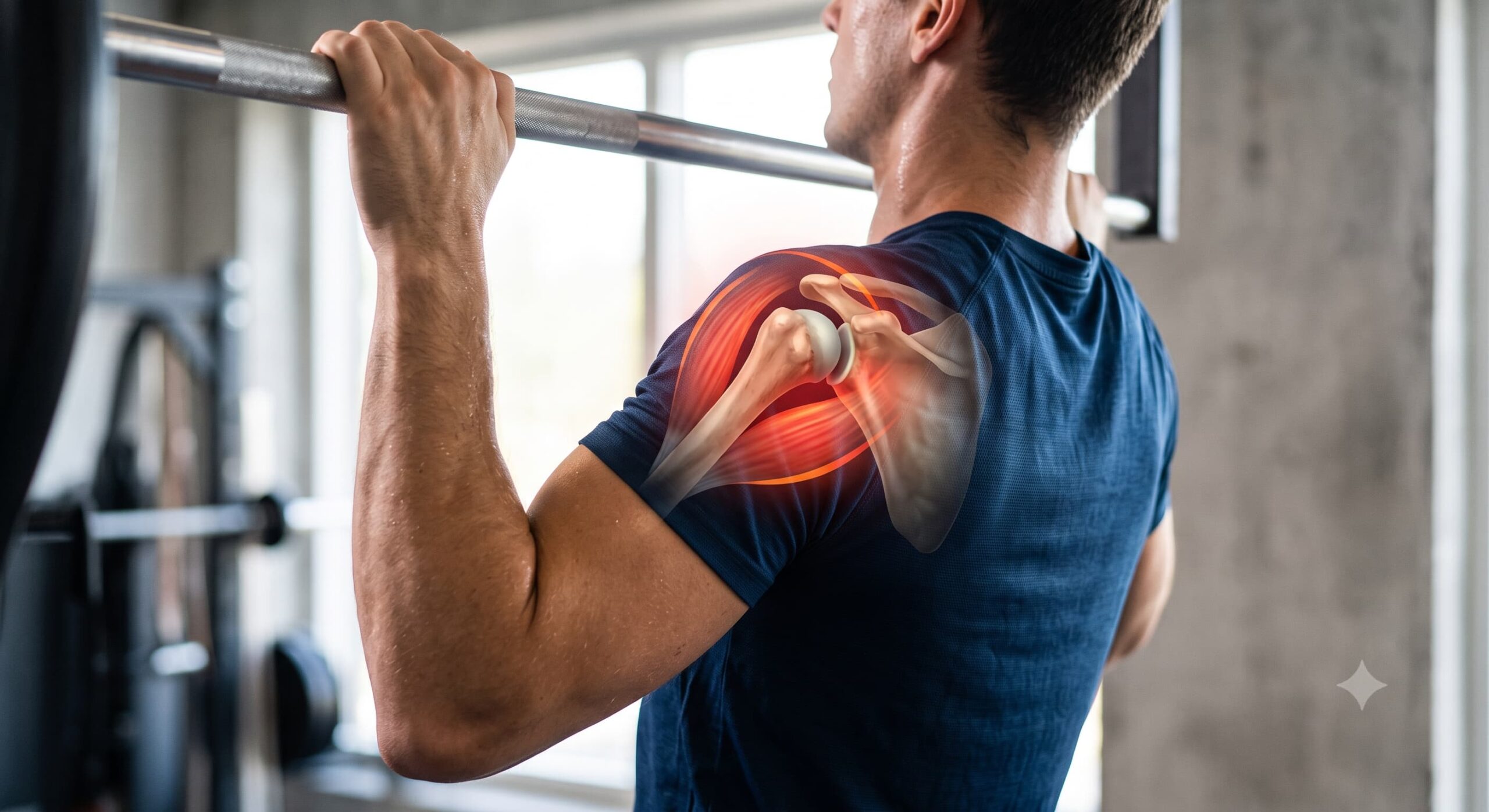
The shoulder is often compared to a golf ball sitting on a golf tee. The “ball” is the head of your upper arm bone (humerus), and the “tee” is a shallow socket on your shoulder blade (glenoid). This brilliant evolutionary design gives the human shoulder an incredible, 360-degree range of motion, allowing us to throw fastballs and hang from bars. However, that massive mobility comes at the direct expense of structural stability.
Because the bony socket is so shallow, the body relies on soft tissue to keep the ball in place:
- The Labrum: A ring of thick cartilage that surrounds the shallow socket, acting like a bumper or a suction cup to deepen the tee and hold the ball securely.
- The Joint Capsule and Ligaments: A web of strong, fibrous tissue that wraps the entire joint, acting as the static restraint system.
- The Rotator Cuff: Four deep muscles (supraspinatus, infraspinatus, teres minor, and subscapularis) that act as the dynamic restraint system, actively pulling the ball tightly into the socket during movement.
The Anterior Dislocation (95% of Cases)
When a shoulder dislocates, it almost always pops out the front (anteriorly) and drops down. This typically happens when the arm is forced into an “abducted and externally rotated” position—think of the exact position your arm is in when you are winding up to throw a baseball, or when you are at the very bottom of a kipping pull-up swing.
When the ball is violently levered out the front of the socket, it causes catastrophic damage to the anterior soft tissues:
- Bankart Lesion: The ball tears the labrum cartilage right off the front of the bone.
- Capsular Stretching: The ligaments at the front of the shoulder are permanently stretched out, much like a blown-out rubber band.
- Hill-Sachs Lesion: As the ball pops out, the back of the soft humeral head scrapes against the hard edge of the socket, often causing an impact fracture or dent in the bone.
Once that front ligament complex is stretched out and the labral bumper is torn, the physical barrier stopping the ball from sliding out again is gone. This is why you feel that terrifying “loose” or “shifting” sensation (apprehension) when you try to hang from a pull-up bar.
The Four Phases of High-Performance Dislocation Rehab
If the static restraints (ligaments and labrum) are permanently stretched, you have to rely entirely on your dynamic restraints (the rotator cuff and scapular stabilizers) to keep the shoulder in the socket. This requires elite-level neuromuscular control.
Here is the exact progression our physiotherapists and kinesiologists use to rebuild that control.
Phase 1: Acute Protection and Isometric Engagement (Weeks 1-3)
Following the reduction (popping it back in), the joint is highly inflamed and vulnerable.
- Immobilization: You will likely use a sling for a short period (1 to 3 weeks, depending on the severity and your doctor’s advice) to allow the acute tissue trauma to settle and the torn labrum to form initial scar tissue.
- Controlling Inflammation: Ice therapy and gentle lymphatic drainage by an RMT help clear the massive swelling.
- Isometric Loading: Just because your arm is in a sling doesn’t mean your muscles should waste away. We introduce gentle isometric contractions. You push your hand or elbow against a wall without actually moving the joint. This safely fires the rotator cuff muscles, preventing rapid atrophy and keeping the neural pathways between your brain and your shoulder active.
Phase 2: Restoring Range of Motion and Scapular Mechanics (Weeks 3-6)
As the pain subsides, the goal shifts to regaining full range of motion without pushing into the “danger zone” (extreme external rotation).
- Scapular Independence: When the shoulder joint is injured, the shoulder blade (scapula) often freezes up to protect it. We must break this pattern. We focus heavily on serratus anterior and lower trapezius exercises to ensure your shoulder blade glides smoothly along your ribcage.
- Active-Assisted ROM: Using dowels, pulleys, and wall slides, we safely reintroduce movement to prevent the capsule from freezing and forming restrictive, adhesive scar tissue.
Phase 3: Neuromuscular Control and Rotator Cuff Strength (Weeks 6-12)
This is where the real work begins. To survive a pull-up, your rotator cuff must automatically fire in milliseconds to keep the ball centered in the socket.
- Rhythmic Stabilization: A practitioner will hold your arm in space and apply unpredictable, multi-directional taps to your wrist. Your job is to keep the arm perfectly still. This trains the central nervous system to reflexively fire the rotator cuff.
- Closed Kinetic Chain Exercises: Exercises where your hand is fixed to a stable surface (like wall planks, bear crawls, and bottoms-up kettlebell carries) force the shoulder stabilizers to co-contract heavily, providing massive joint compression and safety.
- Eccentric Rotator Cuff Loading: We use resistance bands and cables to perform slow, heavy, eccentric internal and external rotation. This thickens the tendons and increases their structural load capacity.
Phase 4: Return to Overhead Athletics (Weeks 12+)
Once baseline stability is achieved, we must bridge the gap between basic rehab exercises and the chaotic, high-velocity demands of functional fitness.
Rebuilding the Pull-Up
A strict pull-up places your shoulder under a massive traction force. The weight of your entire body is actively trying to pull the humerus out of the socket.
To return to this movement safely:
- Scapular Pull-Ups (Active Hangs): We never start with a full pull-up. You must first master the active hang. Hanging from the bar, you pull your shoulder blades down and together without bending your elbows. This engages the lats and lower traps, creating a muscular “shelf” that protects the joint capsule from traction forces.
- Banded Lat Pull-Downs: We simulate the pull-up motion using heavy resistance bands while seated on the floor, allowing you to control the exact amount of resistance.
- Eccentric Pull-Ups: Using a box, you jump to the top of the pull-up position and lower yourself down as slowly as possible (5-10 seconds). This builds eccentric capacity in the lats and biceps, which are critical secondary stabilizers of the anterior shoulder.
Crucial Note on Kipping: Kipping pull-ups should be strictly avoided until strict strength is completely restored. The bottom of the kip swing forces the shoulder into maximal flexion and external rotation, generating an extreme anterior shear force. If your rotator cuff fatigues during a high-rep workout, the static ligaments will fail, and the shoulder will dislocate again.
The Final Boss: Rebuilding the Muscle-Up
The muscle-up is arguably the most dangerous movement for a compromised shoulder. The danger lies in the “transition phase”—the moment you pull your chest over the rings or the bar and roll your shoulders forward to initiate the dip.
During this transition, your shoulder is forced into extreme internal rotation and extension while bearing your entire body weight. This specific mechanical angle pushes the head of the humerus violently forward against the front of the joint capsule. If the anterior labrum is damaged from a previous dislocation, this is the exact position where it will pop out.
To conquer the muscle-up post-dislocation:
- Mastering the False Grip: The false grip shortens the lever arm and relies heavily on forearm strength, taking a significant amount of torque off the shoulder joint during the transition.
- Deep Ring Dips: You must build extreme strength in the bottom of a ring dip. We use banded assistance and weighted strict dips to ensure the pectoralis major and anterior deltoid can handle the load in deep extension.
- The Low Transition Drill: We set the gymnastics rings at chest height while you keep your feet on the floor. You practice the transition phase while bearing only 30% of your body weight, focusing entirely on keeping the humeral head pulled back and centered in the socket, rather than letting it dump forward.
Why Multidisciplinary Care is Essential for Shoulders
Rehabilitating a dislocated shoulder for elite athletic performance requires a multi-pronged approach. Standard physical therapy exercises are only one piece of the puzzle. At Strike Recovery & Performance, we utilize our entire clinical team:
- Physiotherapy & Kinesiology: To program the precise, progressive loading parameters, neuromuscular control drills, and return-to-sport testing required to ensure the joint can handle the demands of the rig.
- Chiropractic Care: A massive secret to shoulder health is thoracic mobility. If your upper back (thoracic spine) is stiff and locked in a rounded position, you physically cannot raise your arms fully overhead. This forces the glenohumeral joint to compensate and hyper-extend, pushing the ball forward into the danger zone. Chiropractic adjustments to the thoracic spine unlock the upper back, instantly improving overhead mechanics and taking stress off the front of the shoulder.
- Registered Massage Therapy (RMT): After a dislocation, the pectoralis major and latissimus dorsi often become chronically tight, internally rotating the shoulder and pulling the ball off-center. Our RMTs use deep myofascial release to open up the chest and lats, allowing the shoulder blade to sit flush against the ribcage.
Don’t Let a Dislocation End Your Athletic Career
A shoulder dislocation is a profound injury, but it does not have to be a life sentence of chronic instability or the end of your functional fitness journey.
The key is recognizing that popping the shoulder back into place is merely step one. To survive the rigors of heavy lifting, pull-ups, and gymnastics movements, you must commit to a structured, active rehabilitation program that rebuilds your neuromuscular control and bulletproofs your dynamic stabilizers.
Do not rely on a sling and a few weeks of rest. If you want to return to the barbell or the rings with absolute confidence, you need expert clinical guidance.
Are you ready to rebuild your shoulder stability and get back to the movements you love? Head to our booking portal and schedule a comprehensive shoulder assessment with our multidisciplinary Burnaby team today.
References:
- Hasebroock, A. W., et al. “Management of primary anterior shoulder dislocations: a narrative review.” Sports Medicine – Open.
- Jaggi, A., & Lambert, S. “Rehabilitation for shoulder instability.” British Journal of Sports Medicine.
- Wilk, K. E., et al. “Current Concepts in the Rehabilitation of the Athletic Shoulder.” Journal of Orthopaedic & Sports Physical Therapy.
- Borsa, P. A., et al. “Mobility and stability adaptations in the shoulder of the overhead athlete.” Sports Medicine.
- Kibler, W. B. “The role of the scapula in athletic shoulder function.” The American Journal of Sports Medicine.
Google Business Profile Post Setup
- Post Type: Update / What’s New
- Suggested Image: A high-quality, professional image of an athlete performing a strict ring muscle-up or a clinician guiding a patient through dynamic shoulder stability exercises with a kettlebell.
- Suggested Call-To-Action (CTA) Button: “Learn More”
- Button Link: Direct link to this new shoulder dislocation article on your website.