

Running a Half Marathon? How to Avoid IT Band Syndrome During Peak Weeks
Important Disclaimer: The information provided in this article is for educational and informational purposes only and does not constitute direct medical advice. Knee pain can stem from various structural issues, including meniscus tears and ligament damage. Always consult with a licensed healthcare practitioner or medical doctor for a proper clinical diagnosis and personalized treatment plan before beginning any physical rehabilitation program.
Running a Half Marathon? How to Avoid IT Band Syndrome During Peak Weeks
As the weather warms up across British Columbia, the local running community hits the pavement with renewed intensity. With major events like the Vancouver Half Marathon fast approaching on June 28th, runners are entering the most critical—and dangerous—phase of their training blocks: the peak mileage weeks.
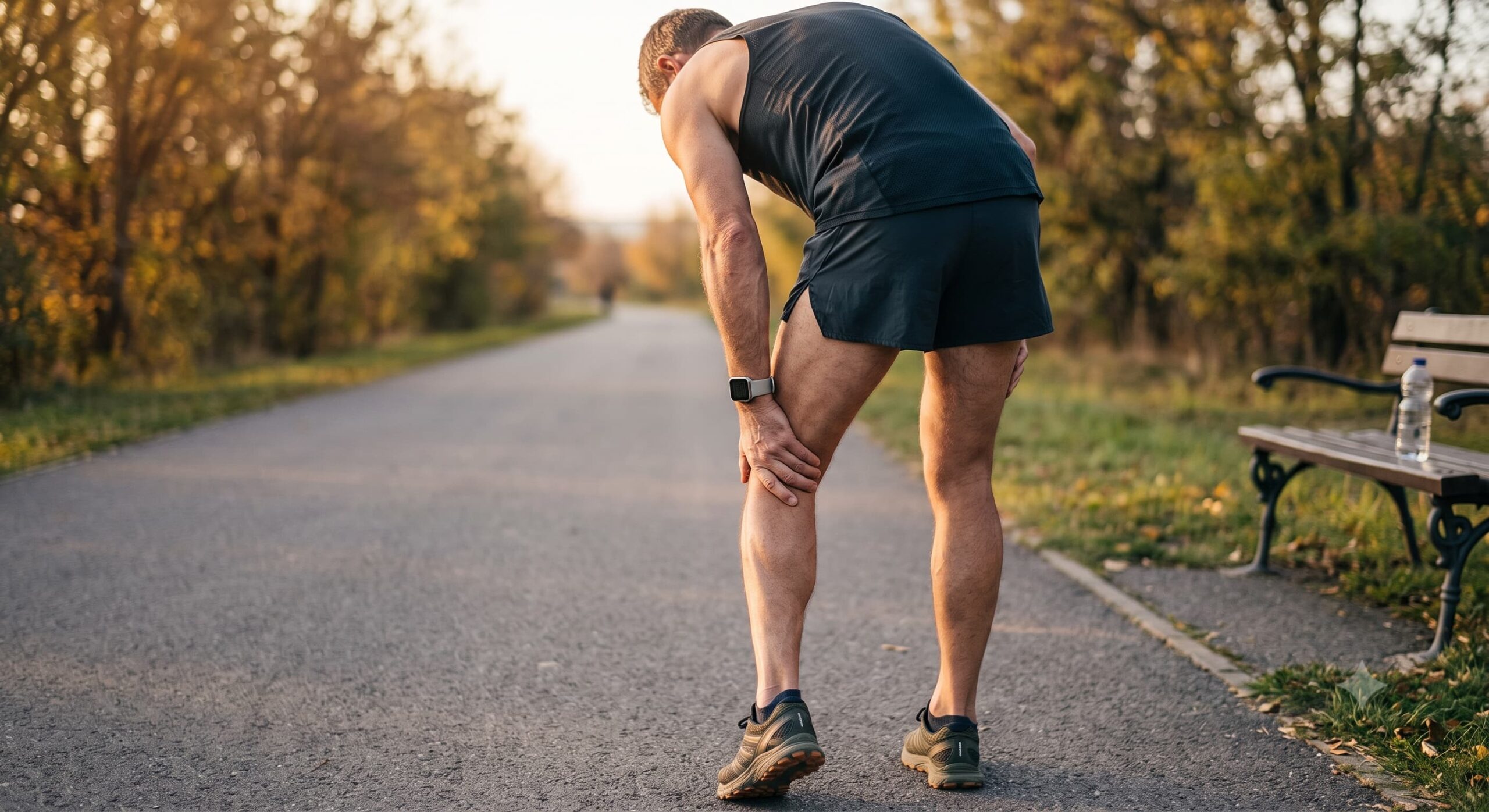
You have diligently followed your training program, progressively adding distance to your weekend long runs. Your cardiovascular system feels phenomenal. But right around kilometer twelve, you feel a sharp, stabbing pain on the outside of your knee. You try to alter your stride, slow down, and shake it out, but the pain only intensifies. Eventually, it forces you to stop and walk. By the time you get home, walking down the stairs is absolute agony.
If this scenario sounds familiar, you are likely dealing with the nemesis of distance runners everywhere: Iliotibial Band Syndrome (ITBS).
When half marathon knee pain strikes, the immediate reaction for most runners is to grab a rigid foam roller and aggressively roll the side of their thigh, hoping to “stretch out” the tight band. Unfortunately, this outdated approach is not only incredibly painful, but it is also biologically ineffective.
If you are looking for evidence-based IT band syndrome running treatments in Burnaby, you must stop attacking the symptom and start addressing the biomechanical root cause. In this comprehensive guide, we will break down the true anatomy of the IT band, debunk the myth of the “friction syndrome,” explain why your glutes are actually to blame, and outline how our multidisciplinary clinical team rebuilds your kinetic chain so you can cross the finish line pain-free.
Anatomy 101: What Exactly is the IT Band?
To understand why your knee hurts, you need to understand the material you are dealing with.
The Iliotibial (IT) band is not a muscle. It is a massive, incredibly thick band of fibrous connective tissue (fascia) that runs down the outside of your thigh. It begins at your hip, where it connects to two major muscles: the Tensor Fasciae Latae (TFL) at the front of the hip, and the Gluteus Maximus at the back of the hip. From there, the band travels straight down the outside of the leg, crosses over the knee joint, and securely anchors directly into the tibia (shin bone) at a spot called Gerdy’s tubercle.
The Function of the IT Band
The IT band acts as a massive, biological stabilizing spring. When you are standing on one leg—which is exactly what running is: a series of single-leg hops—the IT band pulls taut, transferring force from your powerful hip muscles down to your lower leg, preventing your knee from collapsing inward.
Because it connects the hip to the knee, the tension on the IT band is entirely dictated by the muscles it attaches to at the top, and the biomechanics of the joints it crosses at the bottom.
The Great Foam Rolling Myth: Why You Cannot Stretch the IT Band
For decades, the standard medical advice for IT Band Syndrome was to stretch it out. Runners spent hours torturing themselves on foam rollers, trying to lengthen the tissue.
Here is the hard clinical truth: You cannot stretch the IT band.
Biomechanical studies have demonstrated that the IT band has the tensile strength of soft steel. It is structurally designed to withstand immense forces to keep your leg stable. Research has shown that even if you hooked the IT band up to a mechanical winch, you could only stretch it a fraction of a percent before the tissue completely ruptured.
When you aggressively foam roll the side of your leg, you are not lengthening the IT band. Instead, you are aggressively compressing an already inflamed, highly sensitive piece of tissue against the hard femur bone beneath it. This often causes more inflammation and delays your healing process.
Friction vs. Compression: Redefining the Injury
Historically, ITBS was classified as a “friction syndrome.” Doctors believed that as the knee bent and straightened, the IT band snapped back and forth across the lateral epicondyle (the bony bump on the outside of the knee), much like a windshield wiper, creating friction and inflammation.
Modern MRI and anatomical studies have completely debunked this theory.
The IT band is firmly anchored to the femur bone by thick fibrous bands; it does not snap back and forth. Instead, there is a highly sensitive layer of fat and highly innervated tissue located directly underneath the IT band, right at the outside of the knee.
When you run with poor biomechanics, the IT band is pulled incredibly tight against the bone. As your knee bends to approximately 30 degrees (the exact angle your knee hits during the stance phase of running), the IT band maximally compresses this highly sensitive fat pad against the bone.
IT Band Syndrome is not a friction problem; it is a compression problem.
The Biomechanical Root Causes: Why is Your IT Band So Tight?
If the IT band is just a passive piece of connective tissue, why is it suddenly compressing the side of your knee so aggressively? The answer lies in the muscles that control it and the mechanics of your running stride.
1. Severe Gluteus Medius Weakness
This is the single most common cause of IT Band Syndrome in endurance runners. The gluteus medius is a muscle on the side of your hip responsible for stabilizing your pelvis.
When your right foot hits the ground during a run, your right glute medius must fire forcefully to keep your left hip from dropping toward the ground. If your glute medius is weak or fatigued (which frequently happens during peak half marathon training weeks), your pelvis drops.
When the pelvis drops, your femur (thigh bone) is forced to collapse inward (internal rotation and adduction). This inward collapse physically stretches the IT band tight across the outside of the knee, massively increasing the compressive force on that sensitive fat pad with every single step. Your body will also attempt to compensate for the weak glute medius by overworking the TFL muscle, which directly pulls the IT band even tighter.
2. Overstriding and Low Cadence
Your running cadence (steps per minute) dictates how your foot interacts with the ground. Recreational runners often have a slow cadence (around 150-160 steps per minute) and compensate by taking long, bounding strides.
When you overstride, your foot lands far out in front of your center of mass with a relatively straight knee. This straight-knee landing increases the ground reaction force sent up the leg and alters the angle of the knee flexion during the stance phase, keeping the knee directly in the “30-degree impingement zone” for a longer period.
3. Crossover Gait (Running on a Tightrope)
Imagine a straight line drawn on the ground in the direction you are running. Ideally, your right foot should land on the right side of the line, and your left foot on the left.
Runners with ITBS often exhibit a “crossover gait,” where their foot lands directly on, or even crosses over, that imaginary center line (like running on a tightrope). This narrow stance drastically increases the tension on the outside of the hip and the IT band.
4. Downhill Running
Running downhill places a massive eccentric braking load on the quadriceps and forces the knee to spend significantly more time in the 30-degree compression zone. This is why runners often feel perfectly fine on the flats but experience sharp, stabbing lateral knee pain the moment they hit a long descent.
Integrated Treatment: How We Fix IT Band Syndrome
Fixing ITBS requires a fundamental shift in strategy. You must stop trying to treat the victim (the knee) and start treating the culprits (the hip, the pelvis, and the gait).
At Strike Recovery & Performance, our multidisciplinary team utilizes a comprehensive approach to eliminate the compression, restore tissue health, and rebuild your kinetic chain.
1. Manual Soft Tissue Release (Registered Massage Therapy)
While we do not foam roll the IT band itself, our Registered Massage Therapists heavily target the muscles that dictate the tension on the band. By utilizing deep myofascial release, trigger point therapy, and ischemic compression, our RMTs forcefully downregulate the hypertonic Tensor Fasciae Latae (TFL) and the Gluteus Maximus. When these two massive muscles at the top of the hip relax, the tension on the IT band instantly drops, immediately reducing the compressive pain at the knee. We also release the vastus lateralis (the outer quadriceps muscle), which often gets glued to the IT band via restrictive fascial adhesions.
2. Restoring Joint Tracking (Chiropractic Care)
Our Chiropractors analyze the structural alignment of your pelvis, sacroiliac (SI) joints, and ankles. A restricted ankle joint that lacks dorsiflexion will force the foot to overpronate, driving internal rotation straight up the tibia and exacerbating the IT band stretch. Specific adjustments and joint mobilizations restore pristine, symmetrical tracking mechanics, ensuring forces are distributed evenly across the leg.
3. Neuromuscular Re-education and Glute Strengthening (Physiotherapy & Kinesiology)
This is the ultimate cure for IT Band Syndrome. Our active rehab team will program a highly specific, progressive loading protocol to build a bulletproof pelvis.
- Isolation to Integration: We start by isolating the gluteus medius to wake it up. Exercises like side-lying clamshells and lateral leg raises ensure the muscle is firing correctly.
- Functional Weight-Bearing: We quickly transition to functional, closed-chain movements that mimic the demands of running. Heavy lateral band walks, single-leg Romanian deadlifts (RDLs), and Bulgarian split squats train the glutes to stabilize the femur under heavy eccentric loads.
- Pelvic Drop Control: We utilize specific step-down exercises in front of a mirror, providing visual feedback to train your brain to consciously stop the hip from dropping and the knee from caving inward.
4. Gait Retraining (The Cadence Fix)
To permanently offload the knee, we must alter the way you run. A Kinesiologist or Physiotherapist will analyze your running mechanics on a treadmill and implement gait retraining strategies. The fastest intervention is increasing your cadence by 5% to 10% (aiming for 170+ steps per minute). Taking slightly shorter, faster steps physically forces your foot to land directly under your center of mass with a slightly bent knee. This entirely eliminates the crossover gait, reduces overstriding, and pulls the knee out of the dangerous compression zone faster.
When Can You Start Running Again?
The timeline for returning to the road depends on the severity of the inflammation and how quickly you can correct the underlying weakness.
In the acute phase, when the knee is incredibly painful to walk down stairs, you must temporarily pause your running program. Trying to “push through” ITBS is impossible; the pain will only become sharper and more debilitating. During this rest period, we utilize low-impact cross-training (like deep water running or cycling, provided it is pain-free) to maintain your cardiovascular fitness while the inflammation settles.
Once you can perform a single-leg squat without pain and descend a flight of stairs comfortably, a structured return-to-run program begins. We reintroduce running on flat surfaces first, strictly managing your volume and completely avoiding downhill routes until your glutes have demonstrated the capacity to handle the eccentric load.
Secure Your Race Day Success
Training for a half marathon is a massive physical and mental commitment. Do not let lateral knee pain steal your finish line. IT Band Syndrome is a highly predictable, highly treatable biomechanical error. It is your body’s warning system that your hips are fatiguing and your running mechanics are failing under the heavy mileage.
Ditch the foam roller, stop treating the symptom, and start addressing the structural root cause. By combining targeted soft tissue release with aggressive glute strengthening and gait retraining, you can eliminate the compression on your knee and build the resilience required to conquer those final peak training weeks.
Are you dealing with sharp pain on the outside of your knee as your mileage climbs? Head to our booking portal and schedule a comprehensive running and lower-body assessment with the expert rehabilitation team at Strike Recovery & Performance in Burnaby today.
References:
- Fairclough, J., et al. “The functional anatomy of the iliotibial band during flexion and extension of the knee: implications for understanding iliotibial band syndrome.” Journal of Anatomy.
- Fredericson, M., et al. “Hip abductor weakness in distance runners with iliotibial band syndrome.” Clinical Journal of Sport Medicine.
- Straub, R. K., et al. “Iliotibial Band Syndrome in Runners: A Biomechanical Perspective.” Physical Therapy in Sport.
- Heiderscheit, B. C., et al. “Effects of step rate manipulation on joint mechanics during running.” Medicine and Science in Sports and Exercise.
- MacMahon, J. M., et al. “Iliotibial band syndrome: biomechanical implications and exercise interventions.” Sports Medicine.